
- In the first, a teacher explains and students listen.
- In the second, a teacher asks a question, and students debate, build on each other’s ideas, and sometimes change their minds.
- Both classrooms cover the same topic, but only one builds confidence.
- Here’s how classroom discussions turn learners into owners of their learning, and why that matters for self-confidence.
- What “Ownership” Actually Means Student ownership means a learner treats their ideas, questions, and progress as their own.
Picture two classrooms. In the first, a teacher explains and students listen. In the second, a teacher asks a question, and students debate, build on each other’s ideas, and sometimes change their minds. Both classrooms cover the same topic, but only one builds confidence.
Here’s how classroom discussions turn learners into owners of their learning, and why that matters for self-confidence.
What “Ownership” Actually Means
Student ownership means a learner treats their ideas, questions, and progress as their own. They don’t wait to be told what to think. Instead, they help shape the answer.
Discussion is one of the fastest ways to build it. When a learner speaks, defends a view, or says “I disagree, and here’s why,” the idea becomes theirs. Over time, this habit spills into homework, group projects, and even friendships.
Four Things a Good Discussion Gives a Learner
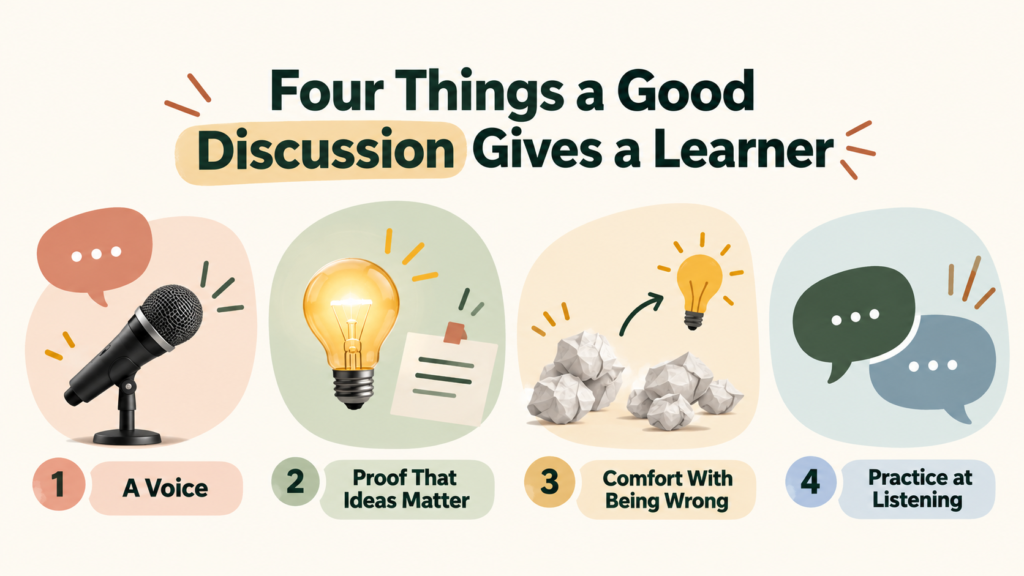
1. A Voice
Speaking in front of peers is practice. With each attempt, the nervousness shrinks a little.
2. Proof That Ideas Matter
When a classmate builds on a point, the speaker sees that their thinking has value.
3. Comfort With Being Wrong
In a discussion, a wrong answer becomes a step towards a better one. As a result, mistakes lose their sting.
4. Practice at Listening
Confidence isn’t only about talking. Learners who listen well respond more clearly and respectfully.
Lecture vs Discussion: What Changes for the Learner
| Moment | Lecture-Led Class | Discussion-Led Class |
|---|---|---|
| Who thinks hardest | Mostly the teacher | Every learner |
| What a mistake means | Something to hide | Something to explore |
| Who owns the answer | The textbook | The group |
| What confidence grows from | Getting it right | Speaking and reasoning |
What Ownership Sounds Like
Ownership has a sound. Listen for lines like these:
- “I think this because…”
- “I’d like to add to what she said.”
- “I changed my mind after hearing that.”
- “Can I ask a different question?”
Each line shows a learner who feels safe, heard, and capable.
Signs Confidence Is Growing

Confidence builds slowly, so small signs matter. Over a few weeks, learners volunteer answers sooner, disagree politely, and ask for feedback without being prompted. These small shifts show that ownership is taking root.
Good Discussions Don’t Happen by Accident
Strong discussions need structure. Open-ended questions work better than yes-or-no ones. Equal speaking time stops a few voices from dominating. Meanwhile, a teacher who waits a few extra seconds gives quieter learners room to join.
Above all, respect matters. When everyone knows their ideas will be heard, even hesitant learners start to speak.
Bringing Discussion Home
Conversation at home builds the same muscle. Dinner-table questions like “What do you think, and why?” work well. Likewise, letting children finish their thoughts before correcting them shows that their ideas count.
A Vega Schools Perspective
At Vega Schools, a progressive CBSE school in Gurgaon with campuses in Sector 48 and Sector 76 Gurugram, discussion sits at the centre of everyday learning. As an experiential learning school, Vega pairs inquiry, projects, and circle talks, so learners practise reasoning aloud. Consequently, they grow into confident speakers and independent thinkers.
FAQs
Q1. How do classroom discussions build self-confidence?
Each time a learner shares an idea and sees it respected, speaking feels easier and self-belief grows.
Q2. What if a learner is shy about speaking?
Start small. Pair talks and small groups make it easier to move towards whole-class discussion.
Q3. Do discussions take time away from academics?
No. In fact, they deepen understanding and help learners remember what they study.
Q4. How can discussion skills be practised at home?
Open-ended questions, patient listening, and family conversations where every voice counts all help.
Q5. How do schools in Gurgaon encourage student ownership?
Many CBSE schools in Gurgaon use discussions, circle time, and project based learning to give learners a stronger voice.
Curious how Vega Schools helps learners find their voice? Explore admissions at Vega Schools, a CBSE school in Gurgaon with campuses in Sector 48 and Sector 76 Gurugram.