
- Should you tie your child’s shoelaces, or let them figure it out?
- Most parents ask some version of this question every day, usually while running late.
- The honest answer depends on your child’s age.
- A task that’s too hard leads to frustration, while one that’s too easy teaches nothing.
- This guide breaks down what independence looks like at each age, from toddlers to teens.
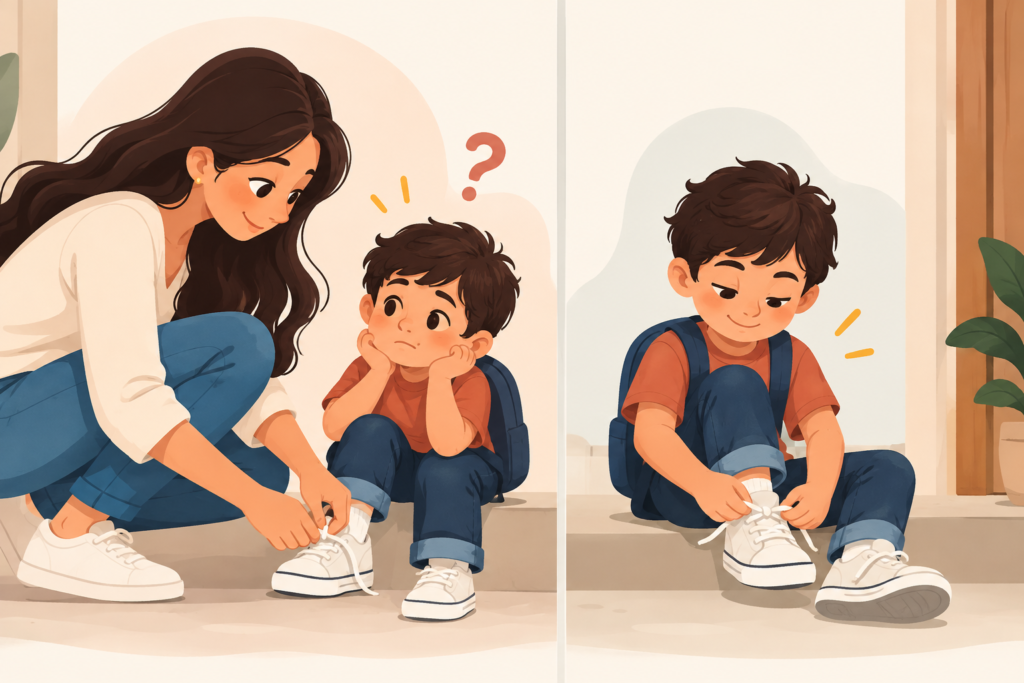
Should you tie your child’s shoelaces, or let them figure it out? Most parents ask some version of this question every day, usually while running late. The honest answer depends on your child’s age. A task that’s too hard leads to frustration, while one that’s too easy teaches nothing.
This guide breaks down what independence looks like at each age, from toddlers to teens. You’ll see what’s realistic at every stage, and know when to step in and when to step back.
Why Independence Grows in Small Steps
Independence isn’t a switch that flips on a certain birthday. Instead, it builds through tiny, repeated chances to try things alone. Every small task a child handles adds to their confidence.
Keep in mind that these milestones are typical ranges, not deadlines. Every child moves at their own pace.
Age-by-Age Independence Milestones
🪜 The Independence Ladder
Tap a rung to see what your child can handle at that age.
- Ages 2–3: "I do it myself"
Toddlers start feeding themselves, choosing between two options, and helping tidy toys. Expect mess. It's part of the process. This is also the stage when many families begin exploring nursery school admission in Gurgaon, so small skills like washing hands and carrying a water bottle make the transition easier.
- Ages 4–5: Building Routines
Children can dress themselves and follow a short morning routine with a picture chart. Meanwhile, they start using words instead of tears to express what they need.
- Ages 6–8: Taking Responsibility
Kids can pack their school bag, set the table, and manage simple homework with a checklist. A forgotten lunchbox at this age is a useful lesson, not a disaster.
- Ages 9–11: Managing Time
Children can use a planner, make a simple snack, and run short errands nearby with clear ground rules. They also begin making small decisions about their own schedule.
- Ages 12 and Above: Owning Decisions
Teens can plan their own study time, manage a small allowance, and speak up for themselves with teachers. At this point, your role shifts from doing to coaching.
Quick Reference: Milestones and Your Role
| Age | Typical Milestone | Your Role |
|---|---|---|
| 2–3 | Feeding self, choosing between two options | Offer choices, allow extra time |
| 4–5 | Dressing, following short routines | Use visual charts |
| 6–8 | Packing bag, simple chores | Check in, don't redo |
| 9–11 | Using a planner, short errands | Set clear ground rules |
| 12+ | Study planning, budgeting | Coach, don't manage |
How to Support Each Step Without Hovering
- Give extra time. Rushing is the fastest way to end up doing it for them.
- Let small mistakes happen. A forgotten book teaches more than a reminder.
- Praise the attempt, not just the result.
- Step back gradually, not all at once.
- Ask "What do you think?" before offering the answer.
What If My Child Seems Behind?
Try not to worry. Milestones vary widely, and comparing children rarely helps. However, if your child struggles in several areas at once, talk to their teacher or paediatrician. Otherwise, keep offering small chances, patiently.
A Vega School Perspective
At Vega Schools, a progressive CBSE school in Gurgaon with campuses in Sector 48 and Sector 76 Gurugram, learners make real choices every day. As an experiential learning school, it builds independence into projects, routines, and classroom decisions. As a result, children practise ownership long before it's expected of them.
FAQs
Q1. At what age should kids start doing things on their own?
As early as age 2, with simple choices like picking a shirt or feeding themselves.
Q2. How do I know my child is ready for more independence?
Look for signs like asking "let me do it" or handling their current tasks reliably.
Q3. Should I step in when my child is struggling?
Offer a small hint first. Giving the full solution too quickly takes away the learning.
Q4. Is it normal for independence to slip backwards?
Yes. Big changes like a new school or sibling can cause temporary setbacks.
Q5. How do schools in Gurgaon support independence?
Progressive CBSE schools in Gurgaon use project based learning and daily choices to help children build ownership step by step.
Curious how Vega School builds independence at every age? Explore admissions at Vega School, a progressive CBSE school in Gurgaon with campuses in Sector 48 and Sector 76 Gurugram.