
- Most conflicts at home are small, loud, and over within minutes.
- Still, they are where children learn the most about getting along.
- Peaceful problem-solving is a skill, and like any skill, it grows with practice.
- This guide covers what is realistic at each age, what to say in the moment, and when adults should step in.
- Start With What Is Realistic for the Age Young children can’t reason calmly in the middle of a fight.
The last piece of mithai. The front seat of the car. Whose turn it is with the tablet. Most conflicts at home are small, loud, and over within minutes. Still, they are where children learn the most about getting along.
Peaceful problem-solving is a skill, and like any skill, it grows with practice. This guide covers what is realistic at each age, what to say in the moment, and when adults should step in.
Start With What Is Realistic for the Age
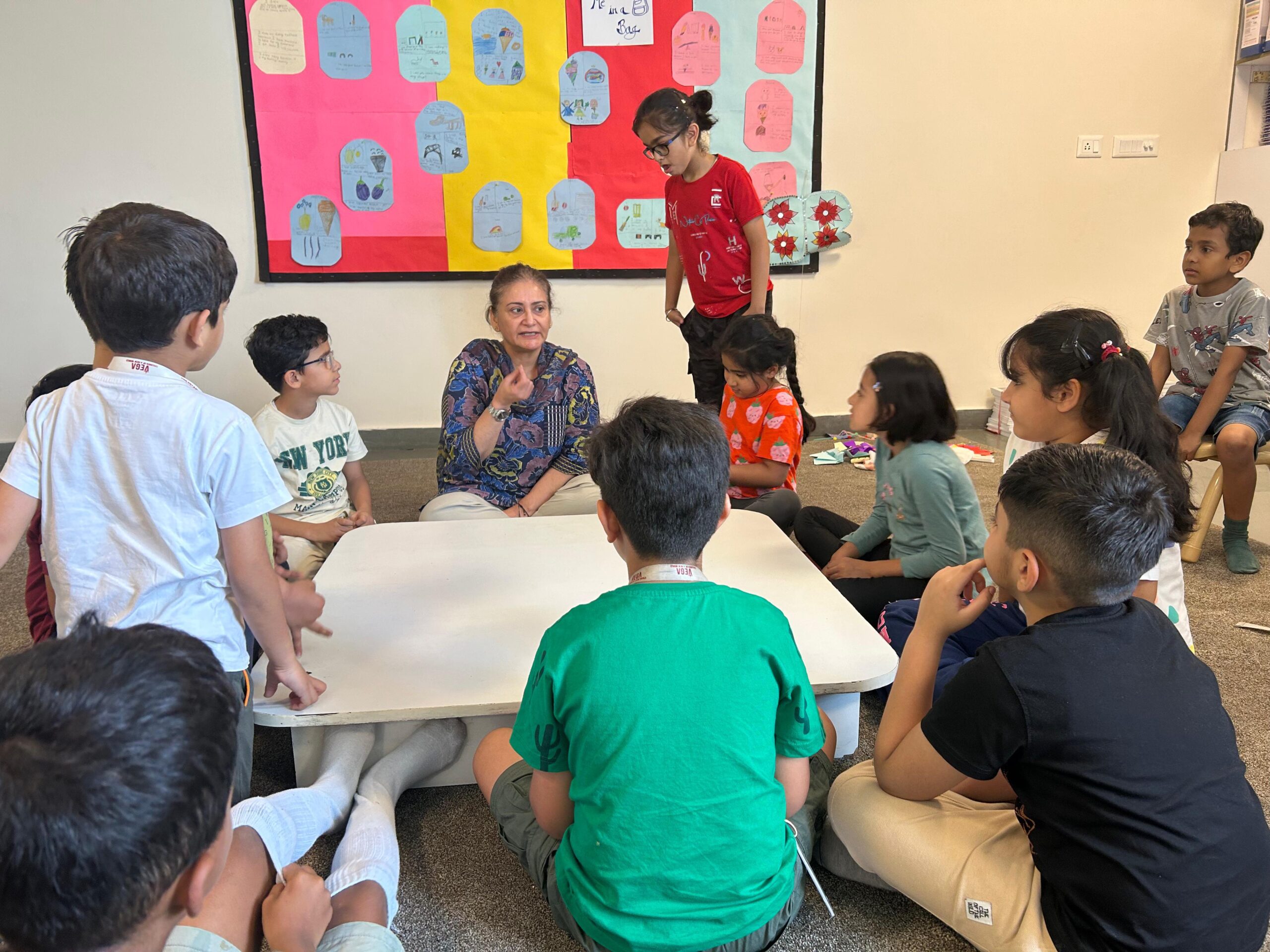
Young children can’t reason calmly in the middle of a fight. The parts of the brain that handle impulse control keep developing throughout childhood and the teen years. So a four-year-old who grabs and shouts is behaving typically, not badly.
| Age | What to Expect | What an Adult Can Do |
|---|---|---|
| 2–4 | Grabbing, crying, few words for feelings | Name the feeling: “You’re upset. You both want the ball.” |
| 5–7 | Can explain what happened, finds sharing hard | Let each child speak once, then ask for ideas |
| 8–11 | Can negotiate, cares about fairness | Stay nearby and let them propose a deal |
| 12+ | Wants privacy and respect | Help only if asked, or if things turn unkind |
Describe Before You Judge
The easiest first step is to say what you see. Don’t pick a side. For example: “I see two of you and one blue marker. You both look upset.” Nobody feels blamed, so things often calm down. Then let each child share their side, one at a time. The other child listens.
Teach the Words, Not Just the Rules
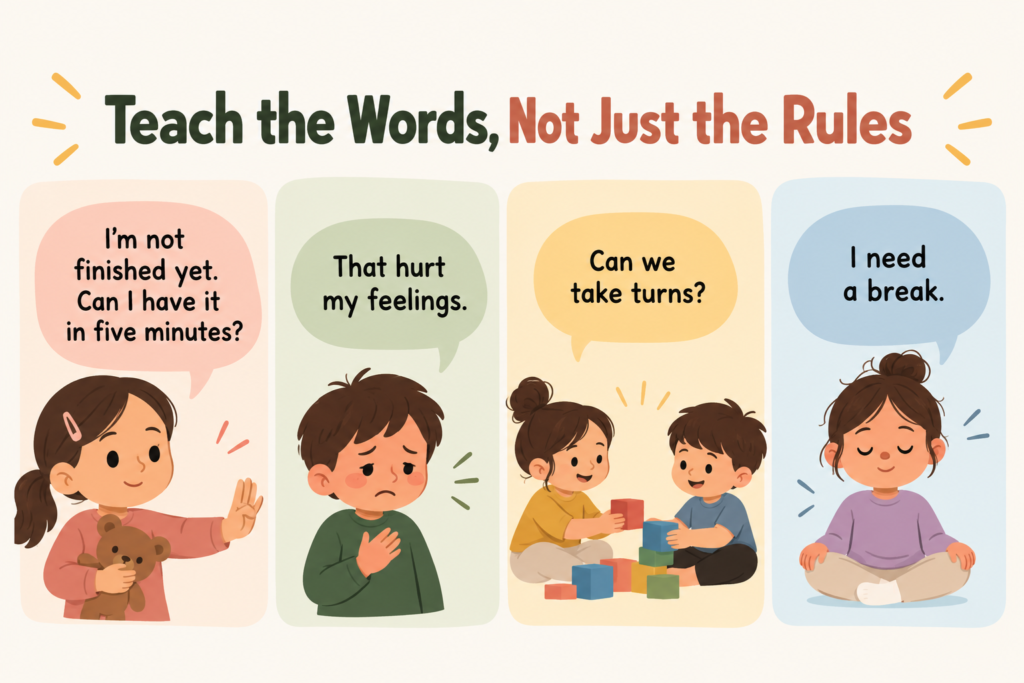
“Say sorry” ends the fight, but it teaches very little. Phrases children can reuse work better:
- “I’m not finished yet. Can I have it in five minutes?”
- “That hurt my feelings.”
- “Can we take turns?”
- “I need a break.”
Children also borrow the language they hear. Therefore, an adult who says “I’m annoyed, I need a minute” gives them a working example.
Hand the Problem Back
Don’t decide who is right. Ask, “What can we do so you both get a turn?” If the idea works, go with it, even if it isn’t the one you would have picked. Check in later to see how it went. Children are more likely to stick with a plan they came up with themselves.
When Adults Should Step In
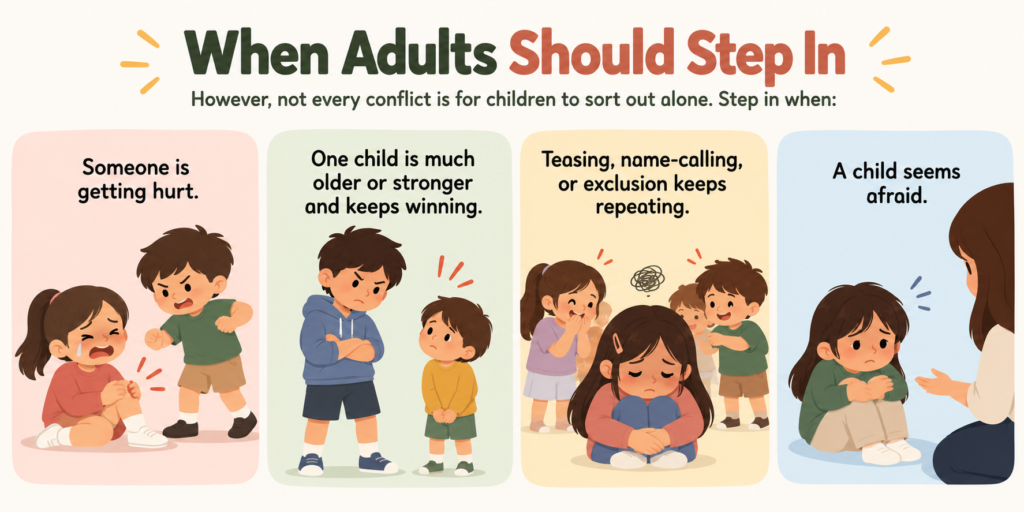
However, not every conflict is for children to sort out alone. Step in when:
- Someone is getting hurt.
- One child is much older or stronger and keeps winning.
- Teasing, name-calling, or exclusion keeps repeating.
- A child seems afraid.
Peaceful problem-solving only works when both sides feel safe.
Practise When Things Are Calm
Fights are a bad time to teach. It’s easier to practise when everyone is calm. For example, act out a disagreement with soft toys. Or ask during a story, “What else could she have done?” That way, children already know what to say when a real fight comes up.
A Vega Schools Perspective
At Vega Schools, a progressive CBSE school in Gurgaon with campuses in Sector 48 and Sector 76 Gurugram, Learning Leaders ask probing questions instead of handing over answers. Circle discussions also give learners a regular place to disagree respectfully. As an experiential learning school, Vega treats everyday disagreements as part of learning.
FAQs
1. Is it normal for siblings to fight often?
Yes. Frequent small fights are common. What matters most is how they end.
2. Should children be made to apologise?
A forced “sorry” rarely builds empathy. Asking “What can you do to make it better?” works more often.
3. What if one child always gives in?
That’s a sign to step in, since the power between the two children may be uneven.
4. How can adults stay calm during a fight?
Take your own pause first. Calm is contagious.
5. How do schools in Gurgaon teach conflict resolution?
Many CBSE schools in Gurgaon use group projects and circle discussions. As a result, children practise disagreeing respectfully.
Curious how Vega Schools builds empathy and collaboration every day? Explore admissions at Vega Schools, a CBSE school in Gurgaon with campuses in Sector 48 and Sector 76 Gurugram.