
- Why does the air suddenly feel different after the monsoon ends?
- Where do all those new birds in the park come from?
- As Gurgaon’s skies clear up and the heat finally breaks, autumn hands parents a free science lesson every single day, if they know where to look.
- Here are simple, outdoor autumn activities that turn this seasonal shift into real, hands-on science for curious kids.
- Why Autumn Is a Natural Science Classroom Autumn here doesn’t look like falling leaves and orange forests, it looks like clearing skies, dropping humidity, and the first cool mornings after months of monsoon.
Why does the air suddenly feel different after the monsoon ends? Where do all those new birds in the park come from? As Gurgaon’s skies clear up and the heat finally breaks, autumn hands parents a free science lesson every single day, if they know where to look.
Here are simple, outdoor autumn activities that turn this seasonal shift into real, hands-on science for curious kids.
Why Autumn Is a Natural Science Classroom
Autumn here doesn’t look like falling leaves and orange forests, it looks like clearing skies, dropping humidity, and the first cool mornings after months of monsoon. Children can actually feel and observe this shift, rather than just hearing about seasons in a book.
This is exactly why experiential learning school environments in Gurgaon use the changing season as a teaching tool, turning the outdoors into a classroom rather than a backdrop.
Simple Autumn Science Activities to Try Outdoors
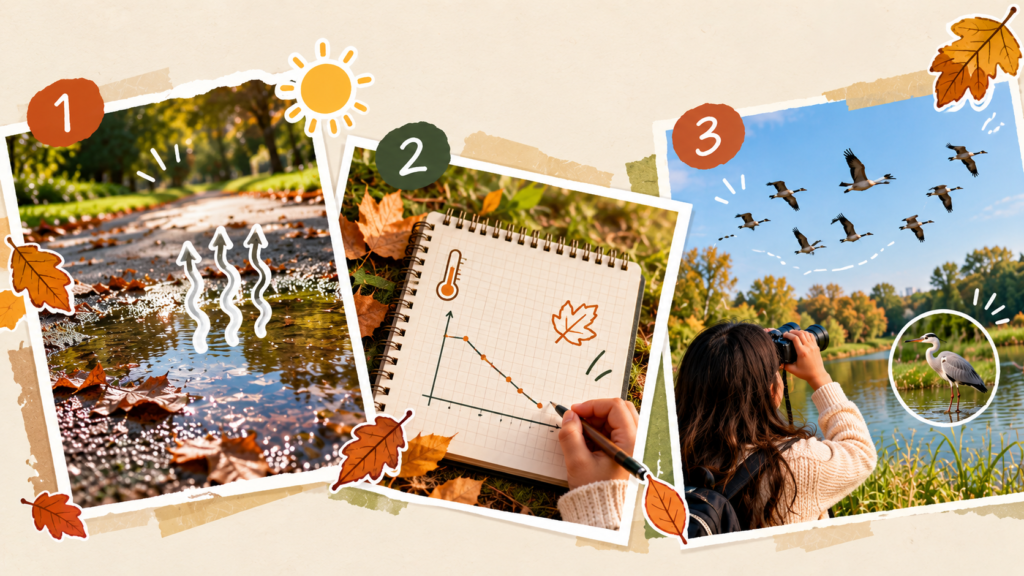
1. Post-Monsoon Puddle Watch
Track how quickly puddles or damp patches dry up as humidity drops through the month, a simple, visible lesson in evaporation.
2. Morning Temperature Journal
Note the temperature each morning for two weeks. As autumn settles in, children can watch the numbers drop and talk about why.
3. Migratory Bird Spotting
Winter brings migratory birds to Gurgaon’s parks and lakes. Spend ten minutes outside spotting new arrivals and discuss where they might be travelling from.
4. Cloud and Sky Watch
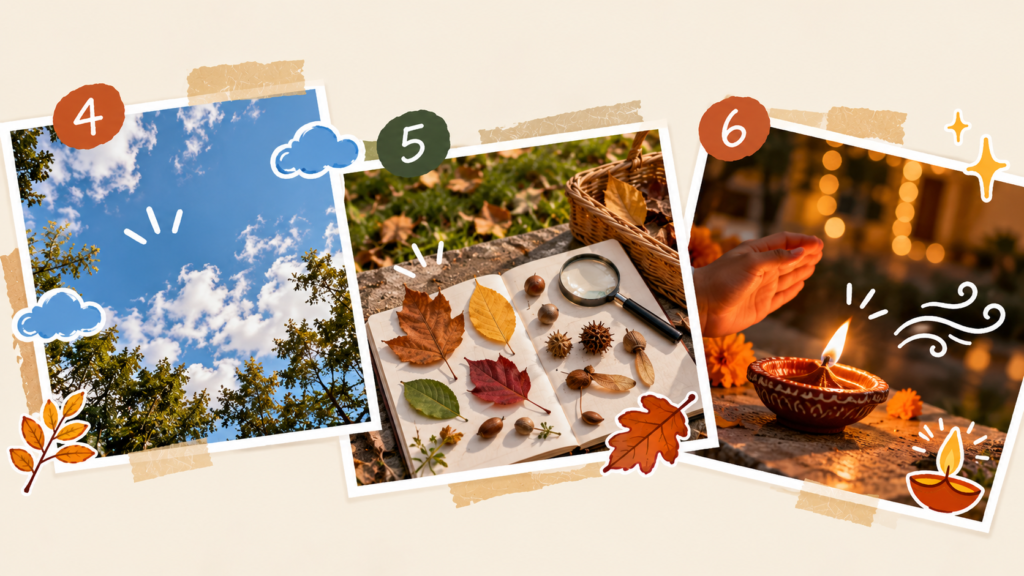
With the monsoon clouds gone, skies turn clearer and bluer. Compare photos of the sky from August to now and talk about why.
5. Seed and Leaf Collection
Many local trees drop seeds and leaves as the season turns. Collect and sort them by shape or size as a simple intro to plant cycles.
6. Diwali Diya Flame Experiment
With Diwali approaching, light a diya (with supervision) and observe how the flame reacts to wind, a simple, festive lesson in air movement and combustion.
Quick Reference: Activity vs Science Concept
🍂 Autumn Science: Tap to Reveal
Tap each activity card to see the science concept behind it.
Making Outdoor Science Part of the Routine
- Keep a small basket by the door for seeds or leaves collected on walks.
- Ask one open question per outing: “Why do you think that happened?”
- Don’t rush to give the answer, let kids guess first.
- Revisit the same spot across a few weeks to notice the gradual change in weather.
Why Outdoor, Seasonal Learning Sticks
Children remember what they’ve touched, smelled, and watched unfold far more than facts read off a page. A season change gives science a built-in timeline that makes abstract ideas, like evaporation or migration, concrete and observable.
This mirrors how a project based learning school approach works, using real-world, hands-on exploration rather than theory alone to build understanding.
A Vega School Perspective
At Vega Schools, a progressive CBSE school in Gurgaon with campuses in Sector 48 and Sector 76 Gurugram, outdoor exploration is part of how science comes alive across the seasons, helping learners connect classroom concepts to the world changing right outside their window.
FAQs
Q1. At what age can kids start outdoor seasonal science activities?
Children as young as 3–4 can enjoy simple activities like bird-spotting or temperature tracking with guidance.
Q2. Do we need a garden or park for these activities?
No, even a balcony, a nearby park, or a short walk works well for most of these activities.
Q3. How often should we do these activities to see real learning value?
A weekly outdoor activity, even just 15–20 minutes, builds noticeable curiosity and observation skills over time.
Q4. Can these activities be combined with schoolwork?
Yes, a temperature journal or bird log pairs naturally with science topics children may already be studying.
Q5. How do schools use seasonal change to teach science?
Experiential learning schools in Gurgaon often use real-world seasonal shifts, like the post-monsoon cooldown, to make science concepts tangible and memorable.
Curious how Vega School brings science to life outdoors? Explore admissions at Vega School, a progressive CBSE school in Gurgaon with campuses in Sector 48 and Sector 76 Gurugram.