
- One finished the worksheet ten minutes ago and is now doodling on the back.
- One is still on the third question, quietly panicking.
- One understands the concept perfectly — but only figured that out when they got up and drew it on the board.
- Three completely different experiences of the exact same lesson.
- And somewhere between all of them — the mythical “average student” the lesson was actually designed for.
Picture a classroom of thirty children. One finished the worksheet ten minutes ago and is now doodling on the back. One is still on the third question, quietly panicking. One understands the concept perfectly — but only figured that out when they got up and drew it on the board.
Three children. Three completely different experiences of the exact same lesson.
And somewhere between all of them — the mythical “average student” the lesson was actually designed for.
What Differentiated Instruction Really Is (And Isn’t)
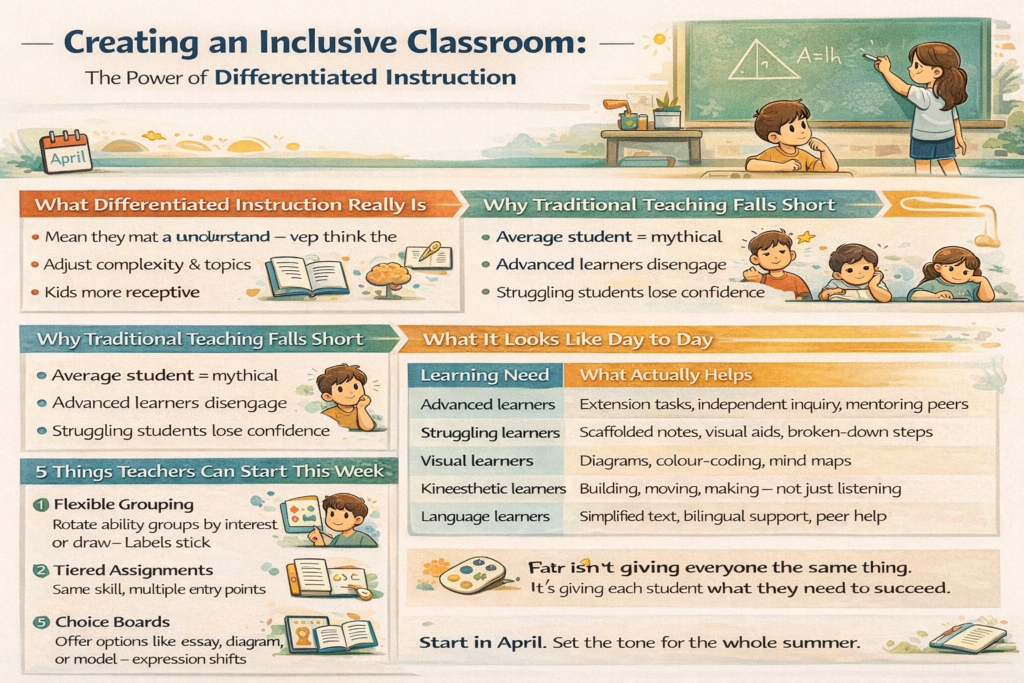
Differentiated instruction does not mean writing thirty individual lesson plans. It means making smarter, deliberate choices about how content is delivered and how students show what they’ve understood — based on who’s actually in the room.
It works across four areas:
- Content — what’s taught and at what level of complexity
- Process — how students make sense of new ideas
- Product — how they demonstrate understanding
- Environment — the conditions that help different learners actually function
Why Teaching Everyone the Same Way Quietly Fails Most of Them
The traditional model was built around an average. The problem is that average barely exists in any real classroom — in Gurgaon or anywhere else.
Struggling students don’t just fall behind — they start believing they’re not capable. Advanced learners don’t just get bored — they quietly learn that school isn’t really for them. The kinaesthetic learner who needs to build something to understand it sits through another explanation that was never going to land anyway.
A classroom that teaches one way is — by design — only reaching some of its students some of the time. That’s a significant amount of wasted potential happening very quietly.

What It Looks Like Day to Day
| Learning Need | What Actually Helps |
| Advanced learners | Extension tasks, independent inquiry, mentoring peers |
| Struggling learners | Scaffolded notes, visual aids, broken-down steps |
| Visual learners | Diagrams, colour-coding, mind maps |
| Kinaesthetic learners | Building, moving, making — not just listening |
| Language learners | Simplified text, bilingual support, peer help |
5 Things Teachers Can Start This Week
1. Flexible Grouping Rotate groups by ability, interest, or random draw. No child should spend a whole year as “the bottom group.” Labels stick longer than teachers realise.
2. Tiered Assignments Same concept, three entry points. Every student heads toward the same goal — on a road that starts where they actually are.
3. Choice Boards Essay, diagram, 60-second recording, or model — the objective is fixed, the expression isn’t. Watch engagement shift immediately.
4. Anchor Activities Fast finishers need somewhere meaningful to go. Real extension — deeper, not just more of the same.
5. Formative Check-Ins Exit tickets, thumb signals, quick polls — not for marking, for knowing. You cannot differentiate based on guesswork.
How Schools Like Vega Schools Gurgaon Approach This
In Gurgaon’s demanding academic environment, differentiated instruction isn’t a nice-to-have — it’s what separates schools that genuinely develop every child from those that serve only the middle.
At Vega Schools, Gurgaon, personalised, student-centred learning is embedded into everyday teaching. Rather than building lessons around a fictional average learner, educators identify where each child actually is — and design pathways accordingly.
For Gurgaon parents evaluating schools, it’s worth asking directly: “How does your school respond when a child is ahead of the pace — or behind it?”
The Mindset Shift That Makes It Work
Differentiated instruction isn’t about lowering expectations for some students. Every student heads toward the same destination. What changes is the starting point and the route.
Treating everyone identically when they arrive differently isn’t fairness. It just looks like it.
FAQs
1. Is differentiated instruction only for students with learning difficulties?
Not at all — it’s equally vital for gifted students needing challenge and average students who absorb information differently.
2. How do teachers manage this without burning out?
Start small — one differentiated element per lesson per week. Sustainable always beats ambitious and abandoned.
3. Do students miss whole-class learning?
No — shared instruction still happens. Differentiation changes how students individually engage with it afterward.
4. How does this help neurodiverse students?
Significantly — flexible processes allow neurodiverse learners to access content through pathways that match how their brains actually work.
5. How can parents identify if their child’s school does this well?
Ask: “What happens when my child is ahead of or behind the expected pace?” The answer tells you everything.
infrastructure, facilities, and experienced teachers are a big asset to the learning & development of students, be it for Nursery, Primary or Senior children making Vega Schools the best schools in Gurgaon. For information about admission, please visit the Vega Schools campuses in Sector 48 and Sector 76 Gurugram. Get the best education for you child in New Gurgaon and be part of the top school infrastructure for sector 78, Sector 83, Sector 85, Sector 90, Sector 102, Sector 106 in Gurgaon, near Dwarka Expressway.