
- Summer is wonderful, until September arrives and you realise your child has forgotten half of what they learned.
- The “summer slide” is real, and maths is usually the first subject to slip.
- Keeping logic skills sharp doesn’t require worksheets or a tutor.
- It just requires a little creativity at home.
- Why Maths Skills Fade Fastest Over Summer Maths is a skill built on layers.
Summer is wonderful, until September arrives and you realise your child has forgotten half of what they learned. The “summer slide” is real, and maths is usually the first subject to slip. The good news? Keeping logic skills sharp doesn’t require worksheets or a tutor. It just requires a little creativity at home.
Why Maths Skills Fade Fastest Over Summer
Maths is a skill built on layers. When kids stop practising, the foundation gets shaky and the next school year starts with catch-up instead of progress.
But here’s the thing: maths is everywhere at home. You just need to know where to point it out.
Fun Ways to Sneak Maths Into Everyday Summer Life
In the Kitchen
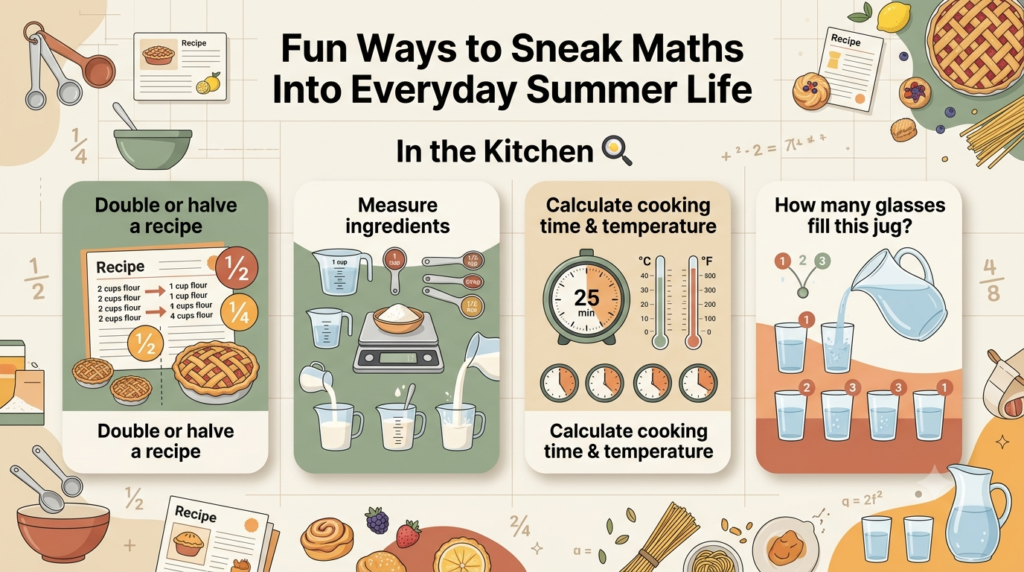
Cooking is applied maths. Get your child to:
- Double or halve a recipe (fractions in action)
- Measure ingredients (units, estimation)
- Calculate cooking time and temperature conversions
Even a simple “how many glasses of water fill this jug?” builds number sense naturally.
On Shopping Trips
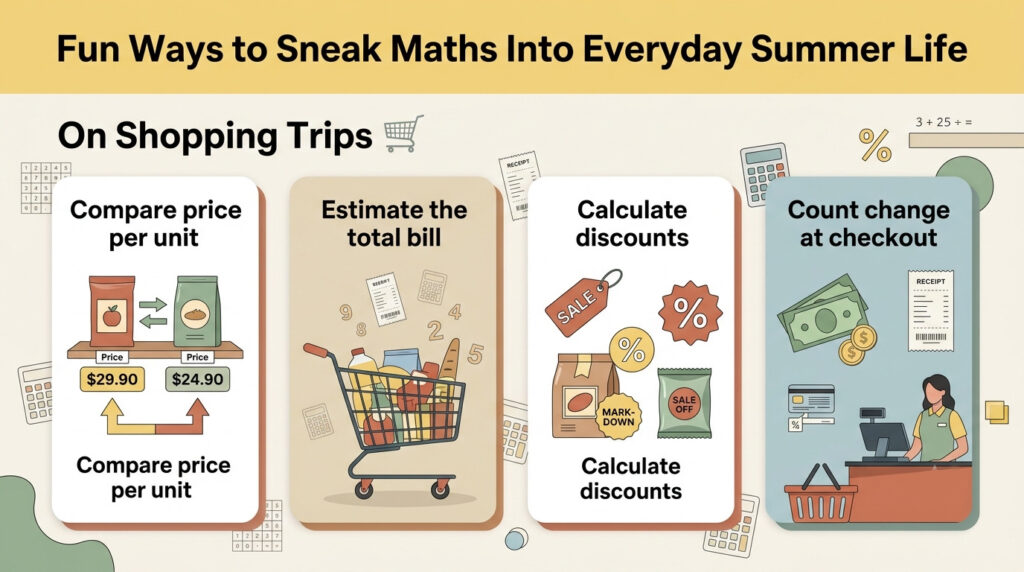
The supermarket is a logic playground:
- Compare price per unit to find the better deal
- Estimate the total before reaching the checkout
- Calculate change or percentage discounts
Kids who do this regularly develop sharp mental maths without ever opening a textbook.
During Games and Puzzles
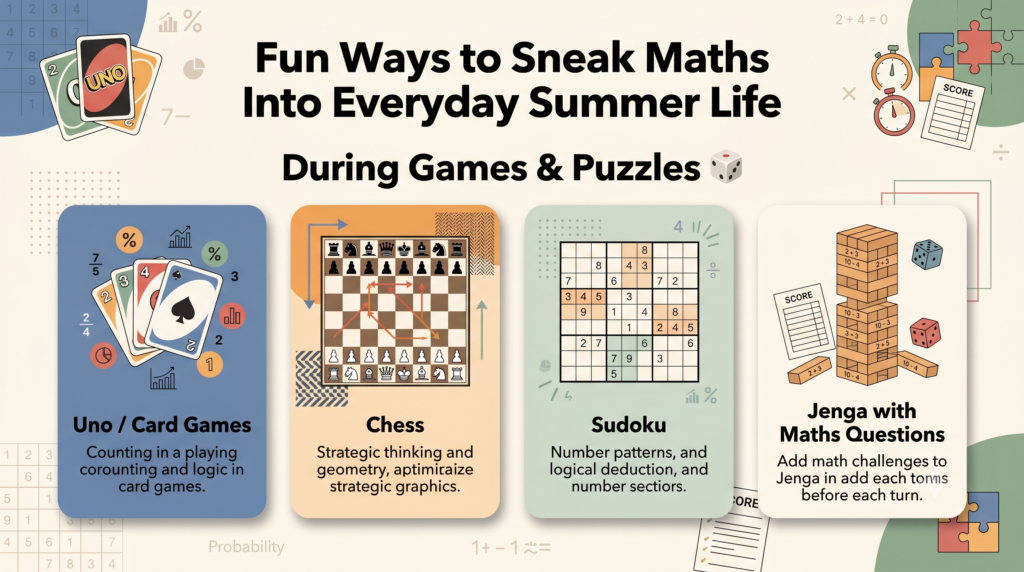
Board games, card games, and puzzles are underrated maths tools:
- Uno / card games — probability and number recognition
- Chess — logical thinking and pattern recognition
- Sudoku — number logic for older kids
- Jenga with maths questions — quick sums before each turn
These don’t feel like studying. That’s the point.
Screen Time That Actually Builds Logic
Not all screen time is wasted time. A few genuinely good options:
| App / Platform | Best For | Age Range |
|---|---|---|
| Prodigy Maths | Curriculum-aligned practice | 6–13 years |
| Khan Academy Kids | Foundational concepts | 4–8 years |
| Mathletics | Problem-solving & challenges | 7–14 years |
| Lightbot | Logic & coding thinking | 6–12 years |
Limit to 20–30 minutes a day, enough to reinforce skills without replacing real-world thinking.
The “Maths Minute” Habit
One of the simplest things parents can do: ask one maths question a day, casually. Not as a test — as conversation.
“If we drive for 2 hours at 60 km/h, how far do we go?” “There are 3 of us sharing 10 biscuits — is that fair? What’s left over?”
It takes 60 seconds and keeps the brain ticking. Over a 10-week summer, that’s 70 small moments of active thinking.
For Different Ages: What to Focus On
- Ages 4–7: Counting, sorting, patterns, and basic shapes in everyday objects
- Ages 8–11: Mental maths, fractions, telling time, and simple budgeting
- Ages 12+: Percentages, ratios, probability, and real-world problem solving
Match the activity to the level — challenge without frustration is the sweet spot.
5 FAQs
Q1. How much maths practice does my child need over summer? Even 15–20 minutes a few times a week is enough to prevent skill loss and keep logic sharp.
Q2. My child hates maths — how do I make it less stressful? Drop the worksheets entirely. Use games, cooking, and everyday situations where maths feels useful, not forced.
Q3. Is it okay to rely on maths apps over summer? Apps are a great supplement, not a replacement. Pair them with real-world activities for the best results.
Q4. At what age should kids start logical reasoning practice? As early as 3–4 years old through sorting, patterns, and simple puzzles — long before formal maths begins.
Q5. How do I know if my child is falling behind in maths? Watch for frustration with basic problems they previously handled easily — that’s usually the first sign.
Maths doesn’t take a summer break. But with the right approach, practising it won’t feel like one either.
Summer Math Magic
Test how well you know your logic skills — and how to keep them sharp all summer long.
Infrastructure, facilities, and experienced teachers are a big asset to the learning & development of students, be it for Nursery, Primary or Senior children making Vega Schools the best schools in Gurgaon. For information about admission, please visit the Vega Schools campuses in Sector 48 and Sector 76 Gurugram. Get the best education for you child in New Gurgaon and be part of the top school infrastructure for sector 78, Sector 83, Sector 85, Sector 90, Sector 102, Sector 106 in Gurgaon, near Dwarka Expressway.