
- Every trail, tide pool, and starry sky is a lesson waiting to happen.
- School doesn’t end when the backpack is hung up.
- Family trips — whether a weekend hike, a visit to a national park, or a long road journey through unfamiliar terrain — are overflowing with chances for real, meaningful learning.
- The kind that sticks long after the trip is over.
- Children absorb so much more when they’re experiencing rather than reading about something.
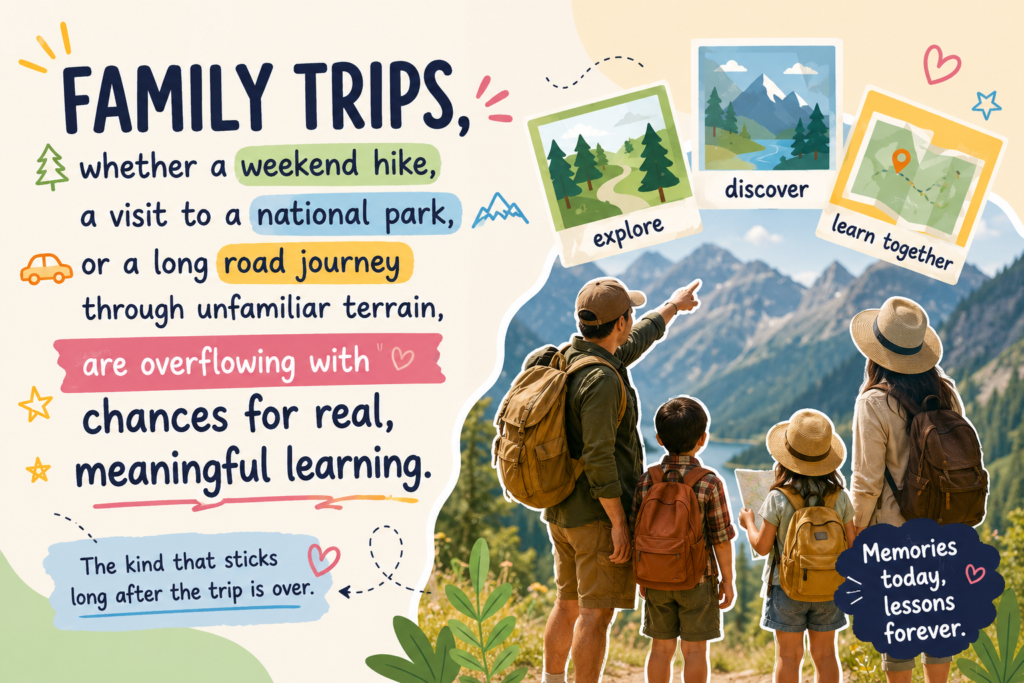
Every trail, tide pool, and starry sky is a lesson waiting to happen.
School doesn’t end when the backpack is hung up. Family trips, whether a weekend hike, a visit to a national park, or a long road journey through unfamiliar terrain, are overflowing with chances for real, meaningful learning. The kind that sticks long after the trip is over.
Moreover, children absorb so much more when they are experiencing rather than reading about something. Nature, in particular, is one of the most generous teachers there is. It asks nothing of a child except curiosity and in return, it gives them the world.
Why Outdoor Trips Are Powerful Classrooms
Research consistently shows that children learn better when they engage multiple senses. For example, a forest trail delivers more about ecosystems than any textbook diagram. Similarly, a river teaches water cycles in a way a worksheet simply can’t. Standing at the edge of a valley and watching fog roll in is a geography lesson no classroom can replicate.
Furthermore, there is something deeply powerful about learning without pressure. Family trips create a safe, curious environment where children feel free to ask questions, explore at their own pace, and make mistakes — all essential parts of real learning.
“Tell me and I forget. Teach me and I remember. Involve me and I learn.” — Benjamin Franklin
As a result, when children are truly involved, not just watching — knowledge stops being abstract. It becomes personal.
Learning Moments Hidden in Every Trip
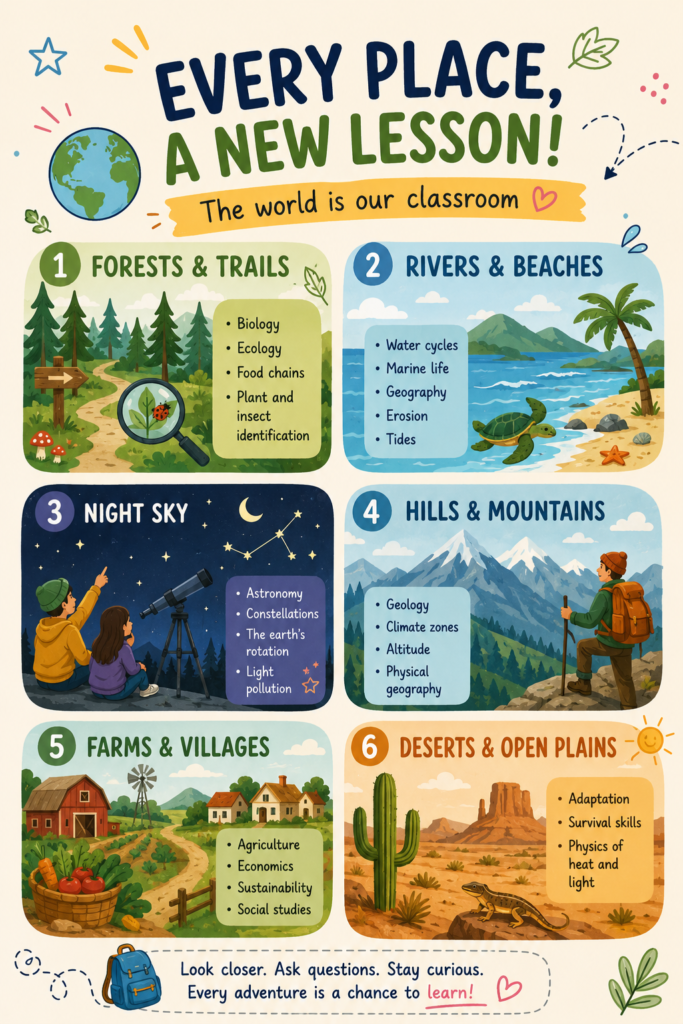
You don’t have to go far or plan elaborate activities. In fact, learning opportunities exist everywhere in nature:
- Forests & Trails — Biology, ecology, food chains, plant and insect identification
- Rivers & Beaches — Water cycles, marine life, geography, erosion, tides
- Night Sky — Astronomy, constellations, the earth’s rotation, light pollution
- Hills & Mountains — Geology, climate zones, altitude, physical geography
- Farms & Villages — Agriculture, economics, sustainability, social studies
- Deserts & Open Plains — Adaptation, survival skills, physics of heat and light
Most importantly, each of these settings offers something a classroom cannot: context. And context is what transforms information into understanding.
How to Turn a Trip Into a Learning Experience
The good news is you don’t need worksheets, quizzes, or lesson plans. Instead, a few simple habits are all it takes:
1. Ask Open Questions
Rather than giving answers, ask things like “Why do you think those rocks are a different colour?” This invites thinking and lets the child work through it on their own.
2. Keep a Nature Journal
Sketching leaves, pressing flowers, drawing cloud shapes, or writing a few lines about the day builds observation, language, and creativity all at once. Additionally, it gives children something wonderful to look back on.
3. Let Kids Lead
Hand a child the trail map. Give them a task — count five different bird species, find three types of rocks, photograph every insect you see. Consequently, responsibility sharpens focus and builds real confidence.
4. Connect to School Subjects
“Remember learning about the water cycle last term? Look — that’s exactly what’s happening right now.” These connections create lasting memory anchors and make school feel relevant.
5. Embrace “I Don’t Know”
When a child asks something you can’t answer, look it up together. As a result, it models one of the most valuable life skills: the willingness to keep learning.
6. Slow Down and Observe
Nature rewards patience. Therefore, sit by a stream for ten minutes. Watch how ants organise. Notice how the wind moves differently through tall grass versus trees. The slower you go, the more you see.
Small Moments, Big Impact
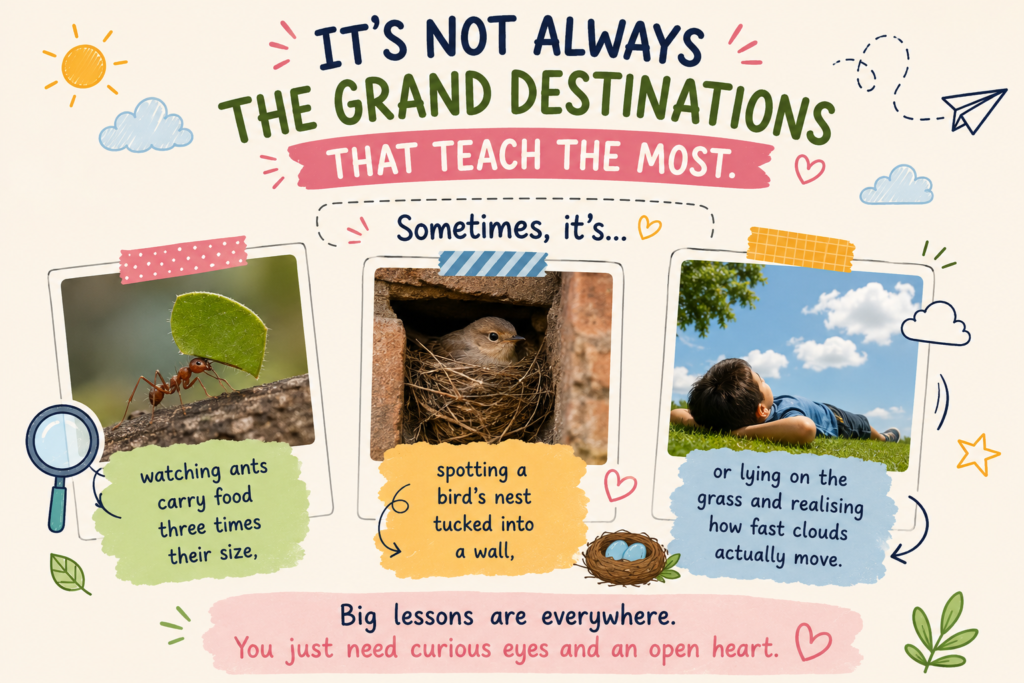
It’s not always the grand destinations that teach the most. Sometimes, it’s watching ants carry food three times their size, spotting a bird’s nest tucked into a wall, or lying on the grass and realising how fast clouds actually move.
As a result, these micro-moments quietly build a child’s sense of wonder, their scientific thinking, and their ability to pay attention in a world full of distractions.
Ultimately, the goal was never to turn every family trip into a lesson plan. It’s simply to stay curious together — to ask questions, explore without a script, and let the world do what it has always done best: teach. That habit, cultivated early, truly lasts a lifetime.
Frequently Asked Questions
Q1. How do I make outdoor trips educational without making them feel like school? Keep it playful and curiosity-led. Ask open questions, explore together, and avoid structured quizzes — the learning happens naturally through experience and conversation.
Q2. What age is best to start nature-based learning trips? As early as 4–5 years old. Young children are naturally curious about the outdoors, and even simple observations at that age build a strong foundation for later learning.
Q3. Do family trips actually improve a child’s school performance? Yes. Experiential learning improves memory retention, critical thinking, and subject comprehension — all skills that directly support academic performance across subjects.
Q4. What should I pack to make a nature trip more educational? A small notebook for journaling, a magnifying glass, a basic field guide to local plants or birds, and a phone or camera for documenting what they discover.
Q5. Can nature trips replace classroom learning? They complement, not replace, classroom learning. Outdoor experiences reinforce and deepen what children are already studying in school, making lessons feel relevant and real.
Infrastructure, facilities, and experienced teachers are a big asset to the learning & development of students, be it for Nursery, Primary or Senior children making Vega Schools the best schools in Gurgaon. For information about admission, please visit the Vega Schools campuses in Sector 48 and Sector 76 Gurugram. Get the best education for you child in New Gurgaon and be part of the top school infrastructure for sector 78, Sector 83, Sector 85, Sector 90, Sector 102, Sector 106 in Gurgaon, near Dwarka Expressway.