
- What if the most powerful science lab your child will ever use isn’t at school — it’s at home?
- Every chore, from washing dishes to watering plants, is quietly packed with scientific concepts waiting to be explored.
- In fact, turning daily tasks into inquiry projects is one of the most effective and underused — ways to build a child’s curiosity, critical thinking, and love for learning.
- This isn’t about adding more to your schedule.
- Instead, it’s about seeing what’s already there differently.
What if the most powerful science lab your child will ever use isn’t at school — it’s at home? Every chore, from washing dishes to watering plants, is quietly packed with scientific concepts waiting to be explored. In fact, turning daily tasks into inquiry projects is one of the most effective and underused — ways to build a child’s curiosity, critical thinking, and love for learning.
This isn’t about adding more to your schedule. Instead, it’s about seeing what’s already there differently.
What Is Inquiry-Based Learning — And Why Does It Work at Home?
Inquiry-based learning is a method where students explore concepts by asking questions, making predictions, testing ideas, and drawing conclusions. It’s how real scientists think. And it turns out, the home is perfectly set up for it.
Unlike textbook exercises, home-based inquiry is hands-on, low-pressure, and driven by genuine curiosity. When a child wonders “why does soap make oil disappear?”, that’s not a distraction, that’s the beginning of a chemistry lesson. Moreover, the home gives children the freedom to experiment without the fear of getting the wrong answer.
Six Everyday Chores That Double as Science Experiments
1. Washing Dishes → Surface Tension and Emulsification
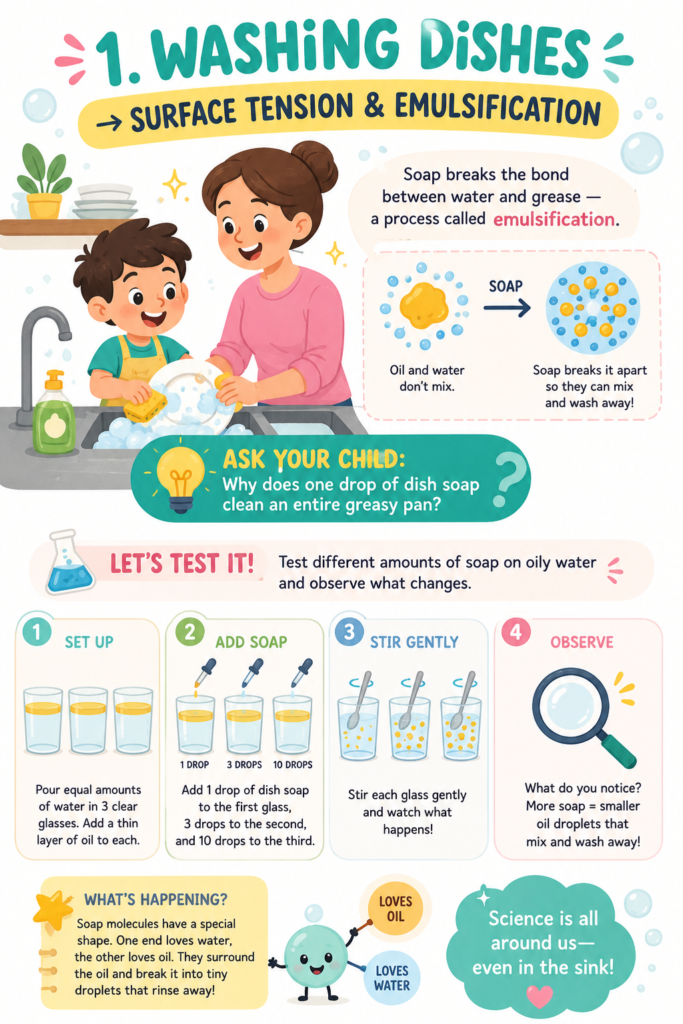
Soap breaks the bond between water and grease — a process called emulsification. Ask your child: why does one drop of dish soap clean an entire greasy pan? As a result, have them test different amounts of soap on oily water and observe what changes.
2. Watering Plants → Transpiration and Photosynthesis
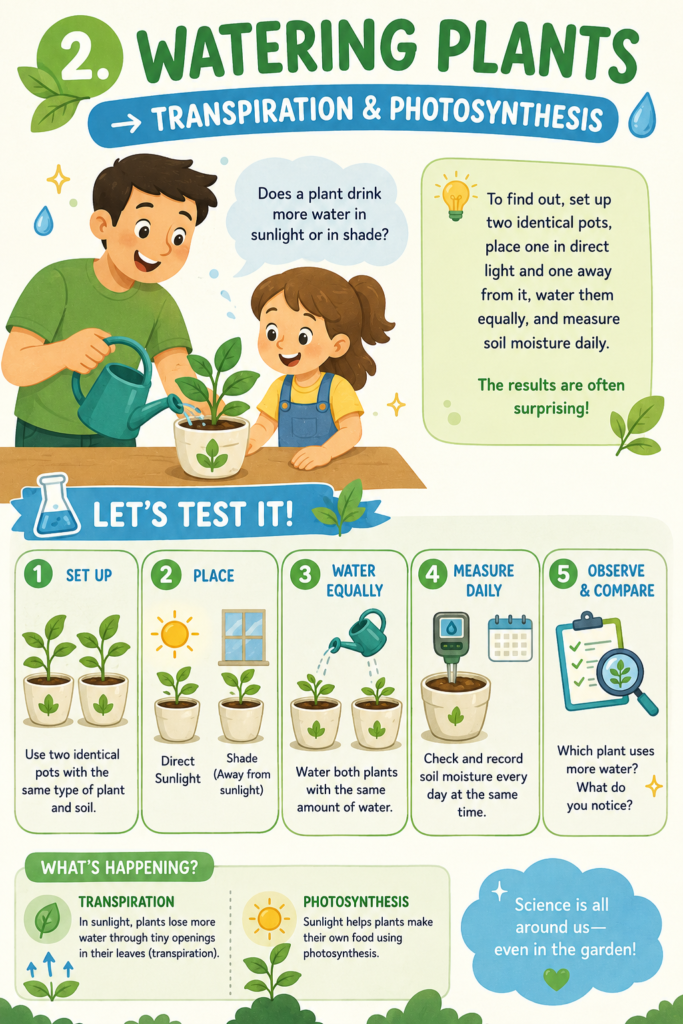
Does a plant drink more water in sunlight or in shade? To find out, set up two identical pots, place one in direct light and one away from it, water them equally, and measure soil moisture daily. The results are often surprising.
3. Sorting Laundry → Materials Science and Heat Transfer
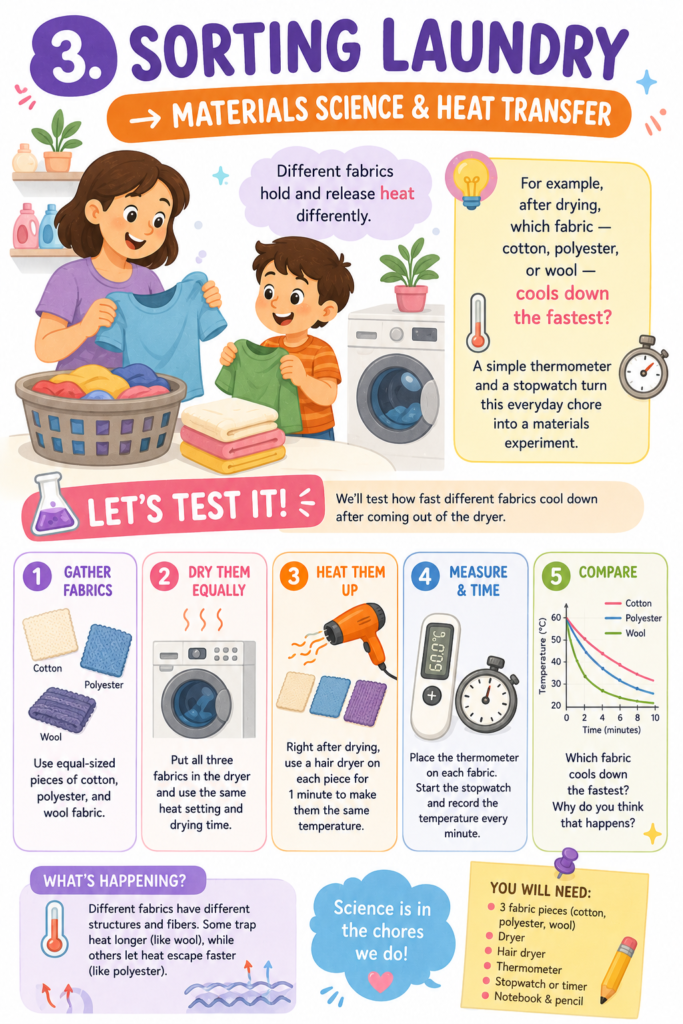
Different fabrics hold and release heat differently. For example, after drying, which fabric — cotton, polyester, or wool — cools down the fastest? A simple thermometer and a stopwatch turn this everyday chore into a materials experiment.
4. Cooking Rice → Osmosis and Boiling Points
Does adding salt to water change how quickly rice cooks? This question touches on boiling point elevation, osmosis, and the chemistry of starch — all of which are core concepts in chemistry syllabi.
5. Sweeping the Floor → Static Electricity
Why does a plastic broom attract dust but a wet mop doesn’t? Exploring static charge and friction gives children a practical introduction to electrostatics that no textbook diagram can fully replace. Furthermore, it connects a daily frustration to a real physics principle.
6. Organising the Fridge → Temperature Gradients and Food Science
The top, middle, and bottom shelves of a fridge are not the same temperature. Consequently, which shelf keeps food freshest the longest? This experiment spans physics, biology, and everyday decision-making all at once.
The 5-Step Inquiry Framework for Any Chore
You don’t need lab equipment. You simply need a repeatable method:
- Observe — notice something unusual or interesting during the chore
- Question — frame it as a “why” or “what if” question
- Predict — write down what you think will happen before testing
- Test — change one variable at a time and record your observations
- Reflect — was the prediction correct? What would you investigate next?
Additionally, keep a dedicated “chore journal” where children log their observations weekly. Over time, it becomes a personalised science notebook and a powerful portfolio of original thinking.
Why This Matters Beyond Curiosity
Home inquiry projects develop the exact skills tested in school practicals, science olympiads, and competitive entrance exams — specifically, observation, hypothesis formation, variable control, and data interpretation. More importantly, they build the habit of asking “why”, a habit that serves students far beyond any exam hall.
The best learners aren’t always those with the most resources. Rather, they’re the ones who find questions in ordinary moments.
So next time there’s a chore to be done, hand a child a notebook first. The experiment is already waiting.
Infrastructure, facilities, and experienced teachers are a big asset to the learning & development of students, be it for Nursery, Primary or Senior children making Vega Schools the best schools in Gurgaon. For information about admission, please visit the Vega Schools campuses in Sector 48 and Sector 76 Gurugram. Get the best education for you child in New Gurgaon and be part of the top school infrastructure for sector 78, Sector 83, Sector 85, Sector 90, Sector 102, Sector 106 in Gurgaon, near Dwarka Expressway.