
- Does switching between languages at home confuse a child, or actually sharpen their thinking?
- Research increasingly points to the latter.
- Multilingual children often develop stronger cognitive flexibility, problem-solving skills, and social awareness than their monolingual peers.
- Here’s why raising a child in a multilingual home builds sharper thinkers, and how to nurture this naturally.
- Why Multiple Languages Strengthen the Brain Switching between languages requires constant mental flexibility.
Does switching between languages at home confuse a child, or actually sharpen their thinking? Research increasingly points to the latter. Multilingual children often develop stronger cognitive flexibility, problem-solving skills, and social awareness than their monolingual peers.
Here’s why raising a child in a multilingual home builds sharper thinkers, and how to nurture this naturally.
Why Multiple Languages Strengthen the Brain
Switching between languages requires constant mental flexibility. Every time a child shifts from one language to another, their brain practises focus, filtering, and quick decision-making, skills that extend well beyond language itself.
This is exactly why experiential learning school environments in Gurgaon increasingly value multilingual exposure, recognising it as a genuine cognitive advantage rather than a source of confusion.
Cognitive Benefits of Growing Up Multilingual
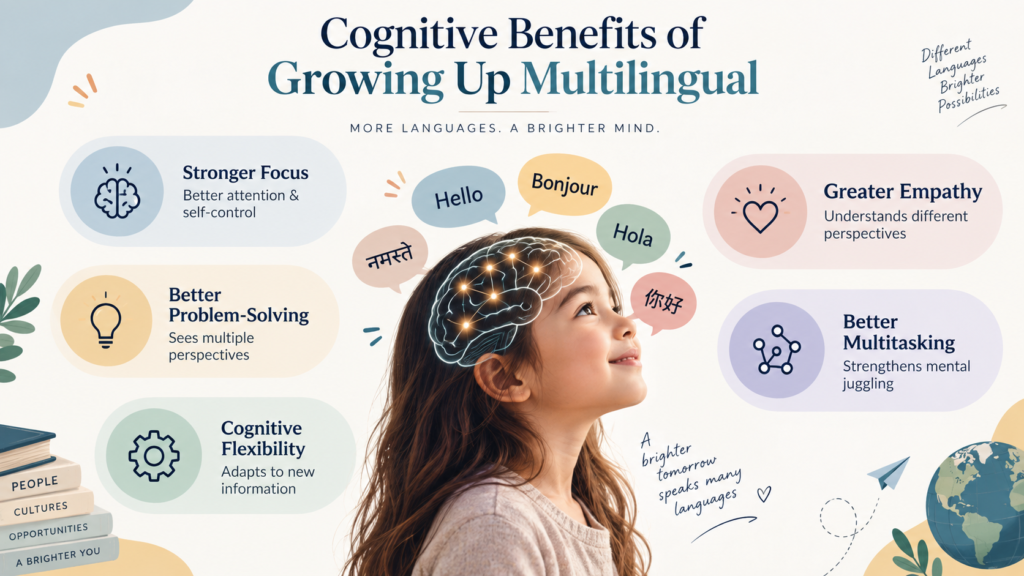
- Stronger executive function: Managing multiple languages builds better focus and self-control.
- Improved problem-solving: Multilingual children often approach problems from multiple angles more naturally.
- Greater cognitive flexibility: Switching languages trains the brain to adapt quickly to new information.
- Enhanced empathy: Understanding multiple languages often means understanding multiple cultural perspectives too.
- Better multitasking ability: Managing language systems simultaneously strengthens broader mental juggling skills.
Practical Ways to Build a Multilingual Home
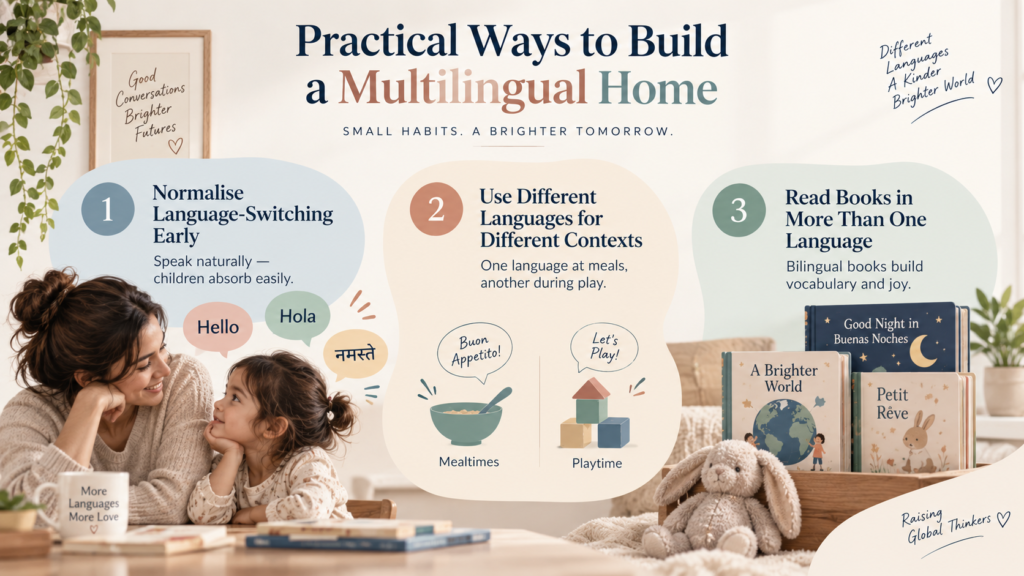
1. Normalise Language-Switching Early
Speak naturally in multiple languages at home, children absorb language patterns far more easily than adults assume.
2. Use Different Languages for Different Contexts
One language at mealtimes, another during play, this helps children associate languages with natural situations rather than rules.
3. Read Books in More Than One Language
Bilingual or multilingual storybooks build vocabulary while reinforcing that switching languages is normal and enjoyable.
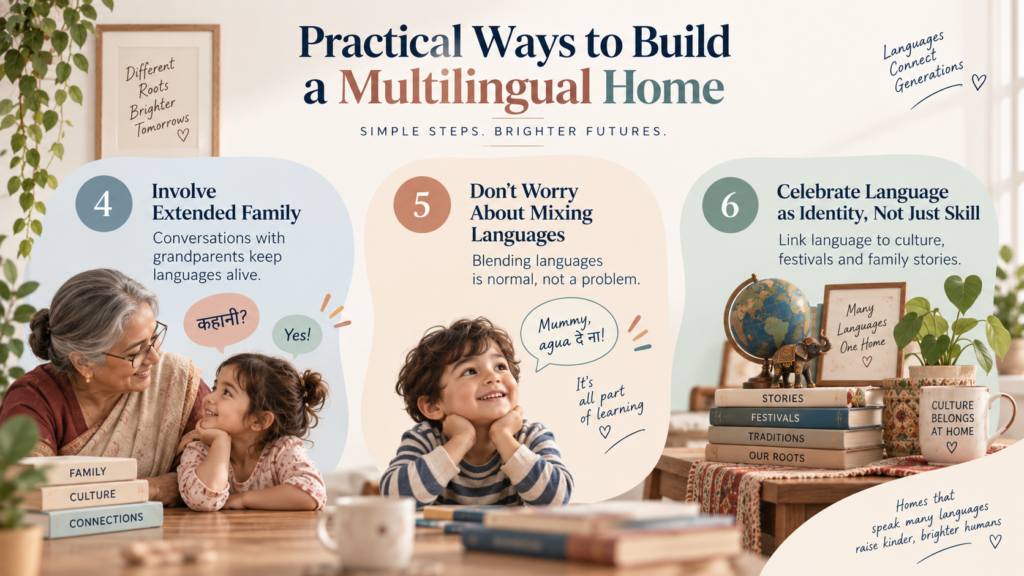
4. Involve Extended Family
Conversations with grandparents or relatives in a regional language keep that language alive and meaningfully used.
5. Don’t Worry About Mixing Languages
Blending languages mid-sentence is a normal developmental stage, not a sign of confusion or delay.
6. Celebrate Language as Identity, Not Just Skill
Connecting language to culture, festivals, and family stories makes learning feel meaningful rather than academic.
Quick Reference: Common Myth vs Reality
| Common Myth | What Research Actually Shows |
|---|---|
| Multiple languages confuse children | Children distinguish languages naturally from an early age |
| Mixing languages means delayed learning | Mixing is a normal, temporary developmental stage |
| One language should be mastered first | Simultaneous language learning is entirely manageable |
| Multilingualism only helps communication | It also strengthens focus, memory, and problem-solving |
Why This Advantage Extends Into Academics
Children raised in multilingual homes often show stronger reading comprehension, abstract thinking, and adaptability in the classroom. These aren’t just language skills, they’re thinking skills that support learning across every subject.
This mirrors how a holistic education school model approaches development, valuing cognitive diversity and varied ways of thinking as much as academic content itself.
A Vega School Perspective
At Vega School, a progressive CBSE school in Gurgaon with campuses in Sector 48 and Sector 76 Gurugram, learners come from richly diverse linguistic backgrounds, and this diversity is treated as a genuine strength, one that sharpens thinking and broadens perspective across the classroom.
FAQs
1. Will learning multiple languages at once confuse my child?
No, children are naturally capable of distinguishing between languages from a very young age without confusion.
2. Is mixing languages in one sentence a sign of a problem?
No, this is a common, temporary phase in multilingual development, not a delay or disorder.
3. At what age should multilingual exposure start?
The earlier, the better, children absorb multiple languages most naturally during early childhood.
4. Does multilingualism actually improve academic performance?
Yes, it’s linked to stronger problem-solving, memory, and comprehension skills that support learning across subjects.
5. How do schools support multilingual learners?
Progressive CBSE schools in Gurgaon that embrace linguistic diversity help multilingual learners thrive both socially and academically.
Curious how Vega School nurtures thinkers from diverse linguistic backgrounds? Explore admissions at Vega School, a progressive CBSE school in Gurgaon with campuses in Sector 48 and Sector 76 Gurugram.