
- When school values stay at school, children often receive mixed signals.
- However, when parents actively mirror those values at home, children develop greater consistency, confidence, and character.
- In short, parent-school alignment isn’t about perfection — it’s about small, intentional habits that reinforce what children learn every day.
- Why Home-School Alignment Matters Children thrive when their two most important environments speak the same language.
- In fact, research consistently shows that students perform better academically and socially when parents and schools work as a unified team.

When school values stay at school, children often receive mixed signals. However, when parents actively mirror those values at home, children develop greater consistency, confidence, and character. In short, parent-school alignment isn’t about perfection — it’s about small, intentional habits that reinforce what children learn every day.
Why Home-School Alignment Matters
Children thrive when their two most important environments speak the same language. In fact, research consistently shows that students perform better academically and socially when parents and schools work as a unified team. As a result, confusion reduces, discipline strengthens, and trust grows — both in authority figures and in themselves.
Start by Understanding the School’s Core Values
Before aligning routines at home, parents first need to know what they are aligning to. Therefore, consider these starting points:
- Request the school’s value framework or learning philosophy
- Attend orientation sessions and parent-teacher meetings regularly
- Follow school newsletters, updates, and parent portals consistently
At Vega Schools, for instance, values like curiosity, empathy, and responsibility are not just classroom goals — they are life skills worth reinforcing at home as well.
Daily Practices That Bridge Home and School
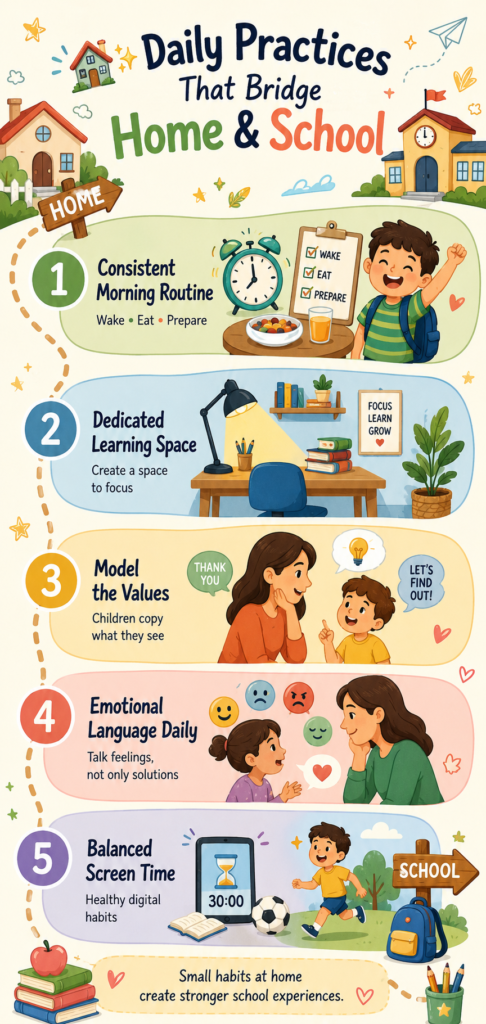
1. Build a Consistent Morning Routine
Morning chaos, above all, undermines a child’s readiness to learn. Therefore, a predictable routine — fixed wake-up time, a calm breakfast, and a prep checklist — mirrors the structured environment that schools work hard to create.
2. Set Up a Dedicated Learning Space
Additionally, a quiet, organised corner for homework and reading sends a clear message: learning matters beyond school walls.
3. Model the Values You Want to See
If school emphasises respect, show it in how you speak at home. Similarly, if it promotes curiosity, explore ideas together and celebrate “I don’t know — let’s find out.” Children ultimately absorb more from what they observe than from what they’re told.
4. Reinforce Emotional Language Daily
Many schools teach children to name and manage emotions. Consequently, asking “How did that make you feel?” at home — rather than jumping to solutions — deepens emotional intelligence over time.
5. Align Screen Time With School Guidelines
Furthermore, matching screen-time rules with the school’s digital wellbeing policies prevents confusion and gradually builds self-regulation.
A Quick Home-School Alignment Check
| Home Habit | School Value It Supports |
|---|---|
| Fixed bedtime and wake-up time | Focus and readiness to learn |
| Reading together before bed | Literacy and curiosity |
| Chores and shared responsibilities | Accountability and independence |
| Family dinner conversations | Communication and empathy |
| Praising effort over results | Growth mindset |
Keep Communication Lines Open
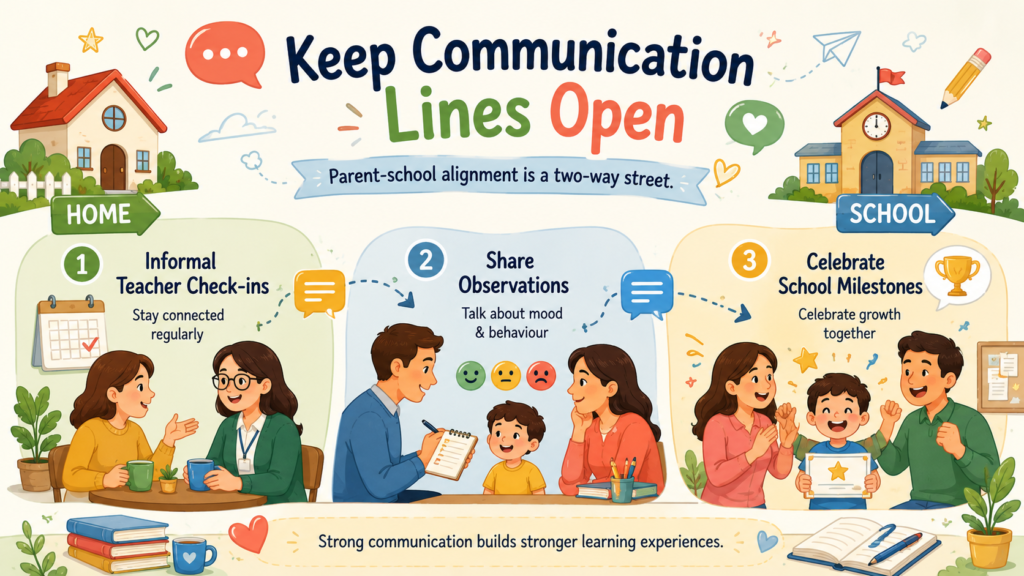
Parent-school alignment is, above all, a two-way street. Rather than waiting for report cards, try these proactive steps:
- Schedule informal check-ins with teachers periodically
- Share observations about your child’s mood or behaviour
- Celebrate school milestones at home so children feel consistently valued
Moreover, when parents and educators collaborate openly, children feel seen, supported, and motivated to grow.
Small Shifts, Big Impact
Ultimately, you don’t need to overhaul your household overnight. Instead, start with one or two habits and steadily build from there. The goal isn’t a perfect home — it’s a connected one, where your child never feels like they’re living two separate lives.
FAQs
Q1. How often should parents communicate with teachers?
Monthly check-ins work well as a baseline, with more frequent contact during transitions or challenges.
Q2. What if home values don’t fully match school values?
Focus on shared ground — respect, effort, and kindness — and maintain an open, ongoing dialogue with the school.
Q3. How can working parents manage routines effectively?
Consistency matters more than time. Even 15–20 focused minutes each evening makes a meaningful difference.
Q4. At what age should children help set routines?
Children as young as 4–5 can participate in simple choices, which naturally builds ownership and cooperation.
Q5. How does Vega Schools support parent engagement?
Vega Schools fosters active partnerships through regular communication, workshops, and collaborative events that keep families closely involved in their child’s growth.
Infrastructure, facilities, and experienced teachers are a big asset to the learning & development of students, be it for Nursery, Primary or Senior children making Vega Schools the best schools in Gurgaon. For information about admission, please visit the Vega Schools campuses in Sector 48 and Sector 76 Gurugram. Get the best education for you child in New Gurgaon and be part of the top school infrastructure for sector 78, Sector 83, Sector 85, Sector 90, Sector 102, Sector 106 in Gurgaon, near Dwarka Expressway.