
- One child understands fractions by drawing them.
- Another gets it by cutting a pizza into pieces.
- A third needs to try the problem a few times before it clicks.
- Same concept, completely different paths.
- Children don’t all learn at the same speed or in the same way.
One child understands fractions by drawing them. Another gets it by cutting a pizza into pieces. A third needs to try the problem a few times before it clicks. Same concept, completely different paths.
That’s normal.
Children don’t all learn at the same speed or in the same way. So expecting every child to respond to one teaching method doesn’t always work. The goal isn’t to find one perfect way to teach every child. It’s to give them different ways to understand, explore, and connect with what they’re learning.
Why Every Child Learns Differently
Think about a classroom of twenty children. They may be the same age, but their interests, experiences, confidence levels, and strengths can be completely different.
One child may ask questions constantly. Another may prefer to observe first. One may understand something after seeing it, while another needs to try it themselves.
These differences don’t mean one child is better at learning than another. They simply show that learning isn’t a straight line.
What Does Learning Differently Mean?
Learning differently doesn’t necessarily mean a child has a learning difficulty. Children naturally respond to different experiences and teaching approaches.
Some children may understand ideas better when they:
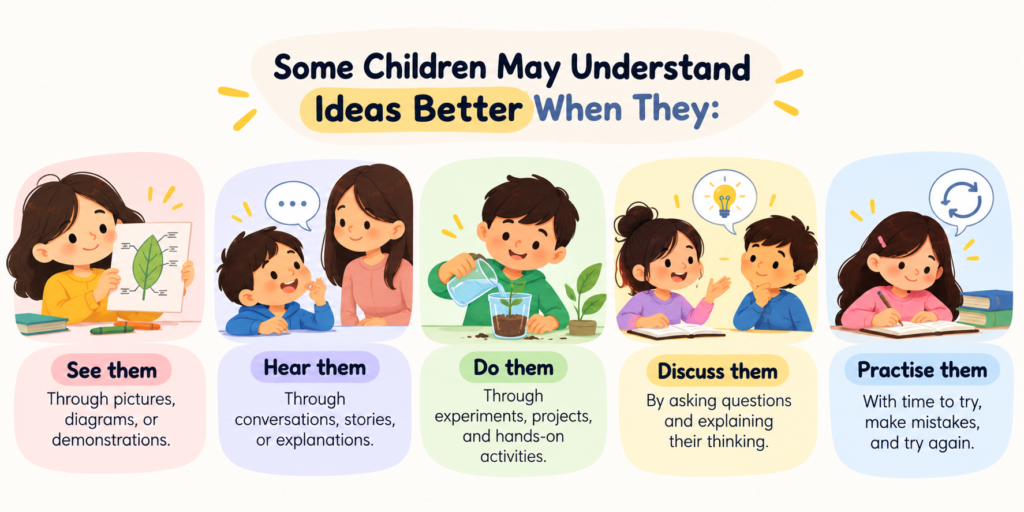
- See them: Through pictures, diagrams, or demonstrations.
- Hear them: Through conversations, stories, or explanations.
- Do them: Through experiments, projects, and hands-on activities.
- Discuss them: By asking questions and explaining their thinking.
- Practise them: With time to try, make mistakes, and try again.
Most children use a combination of these approaches. Giving them different opportunities can make learning more meaningful.
When One Teaching Method Isn’t Enough
Imagine teaching every child to ride a bicycle using exactly the same instructions. Some would start immediately. Others might want to watch first, while some would need several attempts.
Learning can’t work the same way. A child who doesn’t understand something through a textbook might understand it through a model, conversation, experiment, or real-world example. Changing the approach doesn’t lower the standard. It can simply make the path to understanding clearer.
Why Experiential Learning Matters
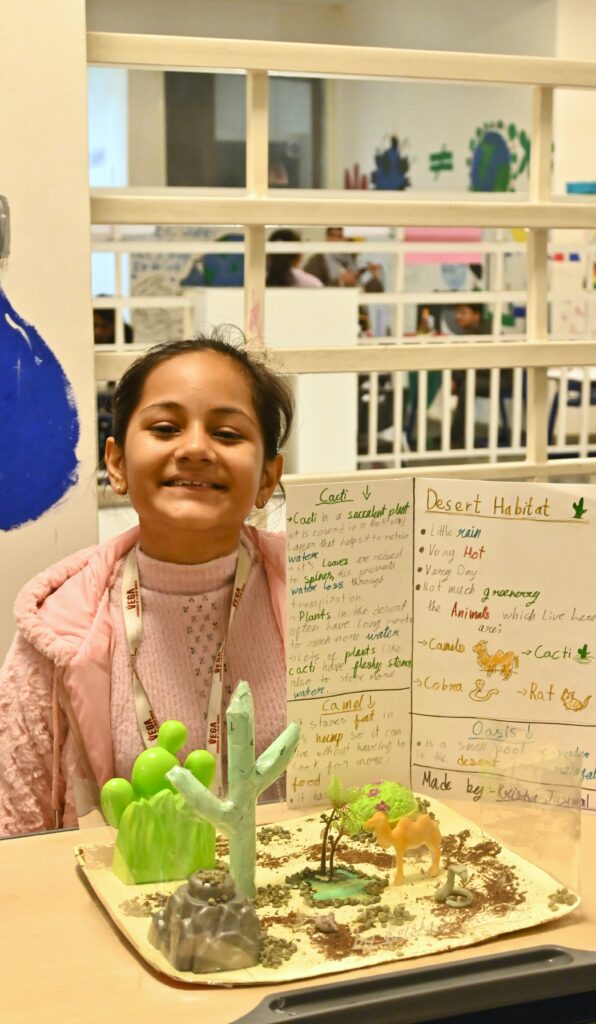
Children often understand ideas better when they can connect them to something real.
Mathematics can come alive while planning a budget. Science becomes more interesting when children can test an idea themselves. Learning about the environment becomes meaningful when they investigate a real issue around them.
This is where experiential learning can help. Instead of simply remembering information, children get opportunities to explore, question, experiment, make mistakes, and try again.
How Parents Can Support Different Learners
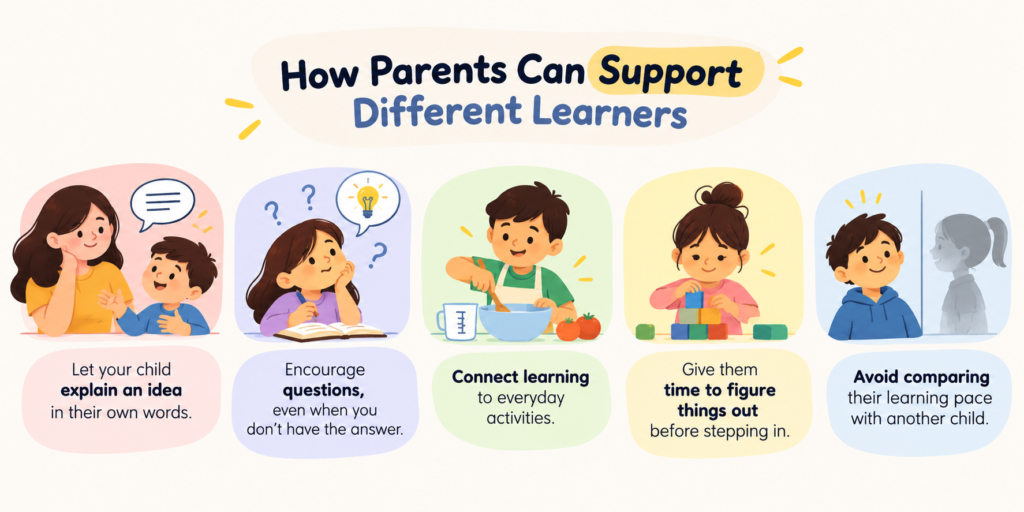
You don’t need to recreate a classroom at home. Small changes can help:
- Let your child explain an idea in their own words.
- Encourage questions, even when you don’t have the answer.
- Connect learning to everyday activities.
- Give them time to figure things out before stepping in.
- Avoid comparing their learning pace with another child’s.
Sometimes, instead of asking, “Why doesn’t my child understand this?”, try asking, “What other way could they explore it?”
A Vega School Perspective
At Vega Schools, a progressive CBSE school in Gurgaon with campuses in Sector 48 and Sector 76 Gurugram, learning recognises that children don’t all arrive at an idea in the same way.
Through experiential learning, projects, collaboration, and real-world experiences, learners get different ways to explore concepts. Children are encouraged to ask questions, make connections, and take ownership of their learning.
The aim isn’t to make every child follow a different path. It’s to give every child the opportunity to find their way into learning.
FAQs
Q1. Why do children learn differently?
Children have different interests, experiences, strengths, and ways of approaching problems, which can affect how they understand new ideas.
Q2. Does learning differently mean a child has a learning difficulty?
Not necessarily. Every child has their own pace and ways of engaging with learning.
Q3. What is personalised learning?
Personalised learning gives children different ways to engage with concepts while working towards shared learning goals.
Q4. How does experiential learning help children?
It allows children to learn through doing, exploring, questioning, and connecting classroom ideas with real experiences.
Q5. How can parents support different learners?
Give children opportunities to ask questions, practise, explore, and explain ideas in their own words. Most importantly, avoid comparing their learning journey with others.
Every child has a different way into learning. The role of education isn’t to make every child take the same path, but to give each learner the opportunity to discover, explore, and grow.