
- Instead of reaching for the TV remote, turn that grey sky into a science classroom.
- Rainy days are actually perfect for hands-on learning, curious kids, and a little kitchen-table experimentation.
- Here’s how to transform monsoon boredom into memorable science lessons at home.
- Why Rainy Days Are Great for Learning Rain naturally sparks questions: Why does it thunder?
- Kids are already curious, this is the perfect moment to turn that curiosity into learning.
Stuck indoors on a rainy afternoon? Instead of reaching for the TV remote, turn that grey sky into a science classroom. Rainy days are actually perfect for hands-on learning, curious kids, and a little kitchen-table experimentation.
Here’s how to transform monsoon boredom into memorable science lessons at home.
Why Rainy Days Are Great for Learning
Rain naturally sparks questions: Why does it thunder? Where does water go after it rains? Kids are already curious, this is the perfect moment to turn that curiosity into learning.
Weather-based science also connects abstract concepts, like evaporation or the water cycle, to something children can actually see and hear.
6 Fun Rainy Day Science Activities
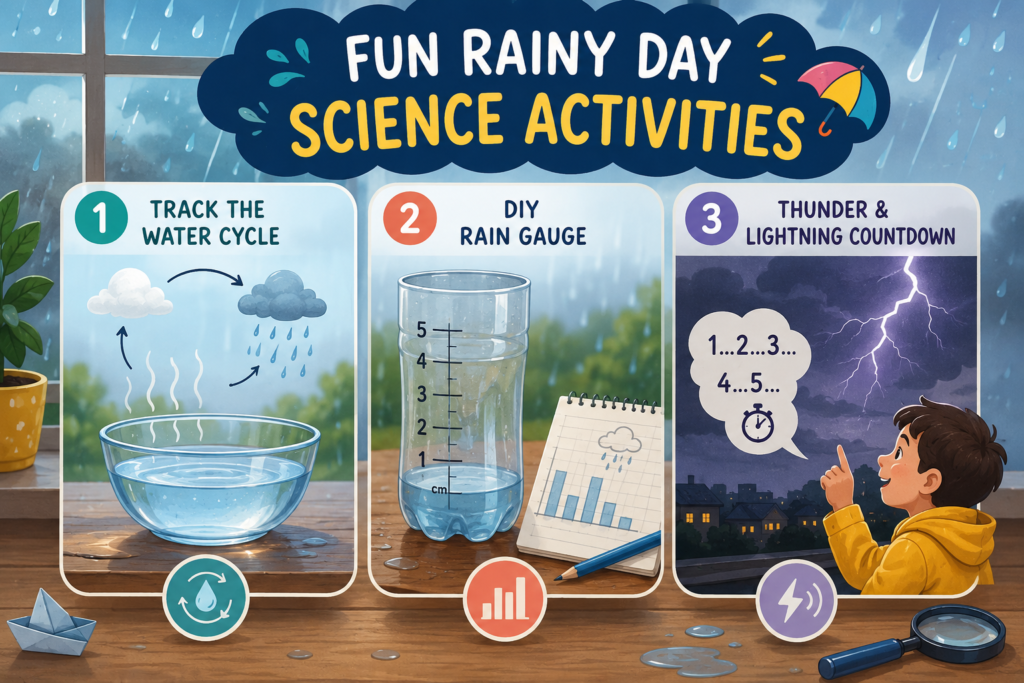
1. Track the Water Cycle Live
Place a bowl of water on a windowsill and observe it over a few days. Talk about evaporation, clouds, and how the rain outside connects to that same cycle.
2. DIY Rain Gauge
Use an empty bottle marked with measurement lines to track daily rainfall. It’s a simple way to introduce measurement, data collection, and basic charting.
3. Thunder and Lightning Countdown
Teach kids to count the seconds between lightning and thunder to estimate distance. This is a fun, safe way to explain sound versus light speed.
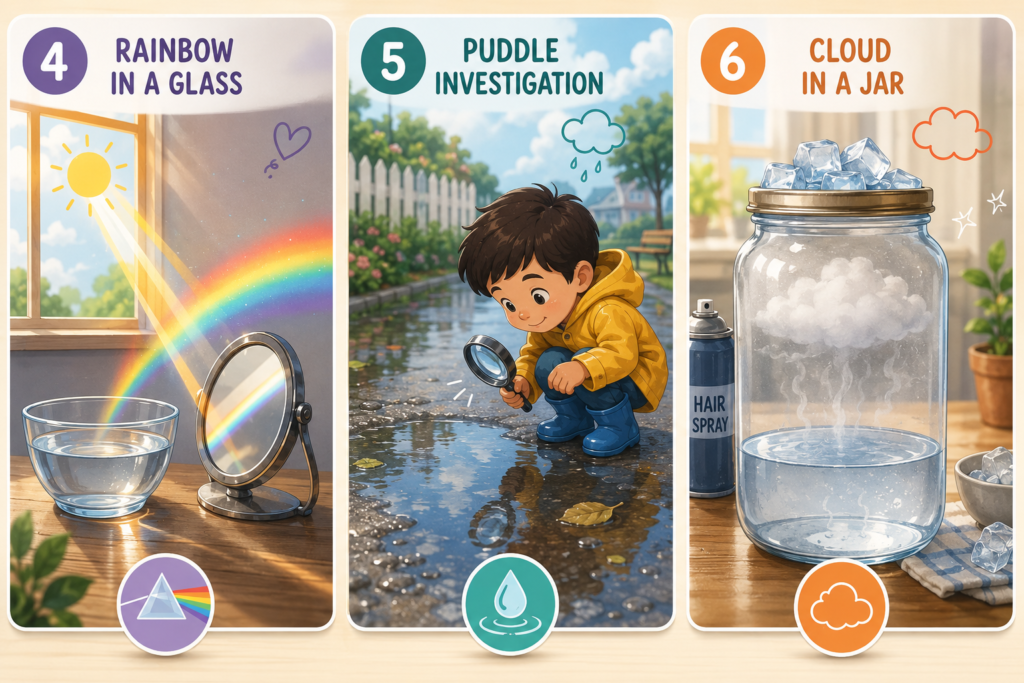
4. Rainbow in a Glass
Using water, a mirror, and sunlight (once it peeks out), kids can create their own rainbow indoors. It’s a hands-on lesson in light refraction.
5. Puddle Investigation
After the rain stops, step outside to examine puddles. Discuss evaporation, reflection, and why some puddles disappear faster than others.
6. Cloud in a Jar
Using warm water, ice, and hairspray in a jar, kids can watch a mini cloud form. It’s a simple, safe experiment that explains condensation visually.
🌧️ Spin the Rainy Day Science Wheel!
Click the button and let it pick today’s experiment for you.
Quick Reference: Activity vs Concept Taught
| Activity | Science Concept |
|---|---|
| Water Cycle Windowsill | Evaporation |
| DIY Rain Gauge | Measurement & data |
| Thunder Countdown | Sound vs light speed |
| Rainbow in a Glass | Light refraction |
| Puddle Investigation | Evaporation & reflection |
| Cloud in a Jar | Condensation |
Tips for Parents to Make It Stick
- Let kids predict outcomes before starting, prediction builds scientific thinking.
- Keep a simple rainy-day journal to record observations and questions.
- Use everyday language first, then introduce the scientific term.
- Don’t rush; let curiosity guide how long each activity lasts.
- Connect activities to real life, ask “why does this matter outside?”
Turning Curiosity Into Confidence
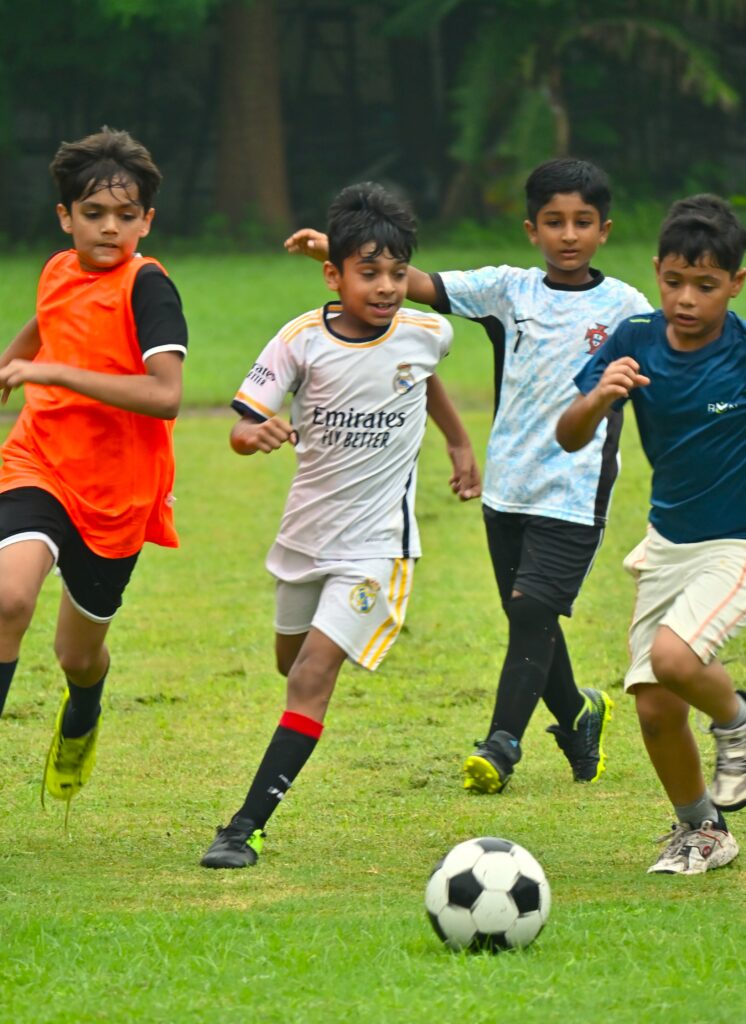
Rainy day experiments do more than fill time, they build observation skills, encourage questions, and make science feel like play rather than a subject to memorize.
This mirrors how strong learning environments work best: through inquiry, hands-on exploration, and real-world connections rather than rote instruction. When children learn to ask “why” and test their own ideas, they carry that curiosity into every subject, not just science.
FAQs
1. What age group is best suited for rainy day science activities?
Most of these activities work well for children aged 5–12, with adult supervision for younger kids.
2. Do I need special equipment for these experiments?
No, most activities use everyday household items like bottles, jars, water, and sunlight.
3. How can I make these activities educational, not just fun?
Ask open-ended questions like “what do you think will happen?” before and after each activity.
4. Are these experiments safe to do indoors?
Yes, all activities listed are child-safe and require no heat or hazardous materials.
5. How do schools encourage this kind of curiosity-led learning?
Schools that focus on inquiry-based, experiential learning help children connect classroom concepts to real-world observations, just like rainy day experiments do.
Curious how curiosity-led learning looks in the classroom? Explore Vega Schools’ inquiry-based approach to science education.
Infrastructure, facilities, and experienced teachers are a big asset to the learning & development of students, be it for Nursery, Primary or Senior children making Vega Schools the best schools in Gurgaon. For information about admission, please visit the Vega Schools campuses in Sector 48 and Sector 76 Gurugram. Get the best education for you child in New Gurgaon and be part of the top school infrastructure for sector 78, Sector 83, Sector 85, Sector 90, Sector 102, Sector 106 in Gurgaon, near Dwarka Expressway.