
- Does your child freeze up during show-and-tell or avoid raising their hand in class?
- Public speaking anxiety often starts early, but the good news is that confidence can be built right at home, through play, not pressure.
- Here are simple, fun ways to help your child become a confident communicator, one activity at a time.
- Why Home Practice Matters Kids learn best in low-stakes, familiar environments.
- Home gives them a safe space to experiment with their voice, body language, and ideas without fear of judgment.
Does your child freeze up during show-and-tell or avoid raising their hand in class? You’re not alone. Public speaking anxiety often starts early, but the good news is that confidence can be built right at home, through play, not pressure.
Here are simple, fun ways to help your child become a confident communicator, one activity at a time.
Why Home Practice Matters
Kids learn best in low-stakes, familiar environments. Home gives them a safe space to experiment with their voice, body language, and ideas without fear of judgment.
Small, consistent practice at home builds the foundation for classroom participation, presentations, and eventually, real-world confidence. It also helps children associate speaking up with comfort rather than anxiety.
7 Fun Activities to Build Speaking Confidence
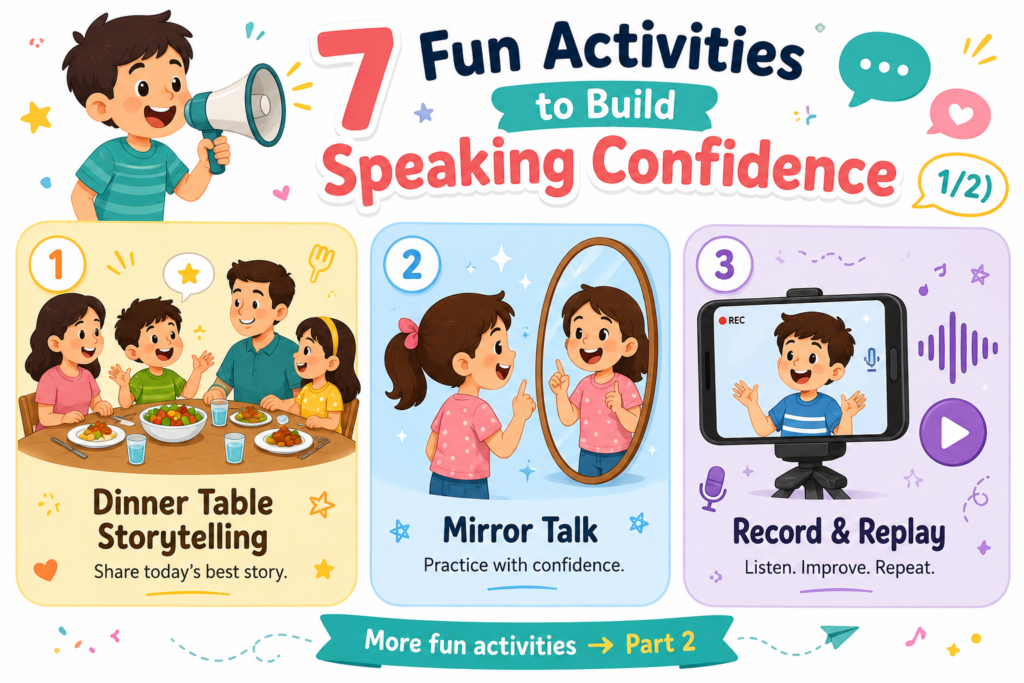
1. Dinner Table Storytelling
Turn mealtime into a mini stage. Ask your child to narrate their day like a news reporter. This builds spontaneous speaking skills without them even realizing it’s practice.
2. Mirror Talk
Have your child practice a short speech or opinion in front of a mirror. Watching their own expressions helps them become aware of body language and tone.
3. Record and Replay
Use your phone to record a 1-minute talk on their favorite topic. Playing it back helps kids self-correct filler words, pacing, and volume naturally.
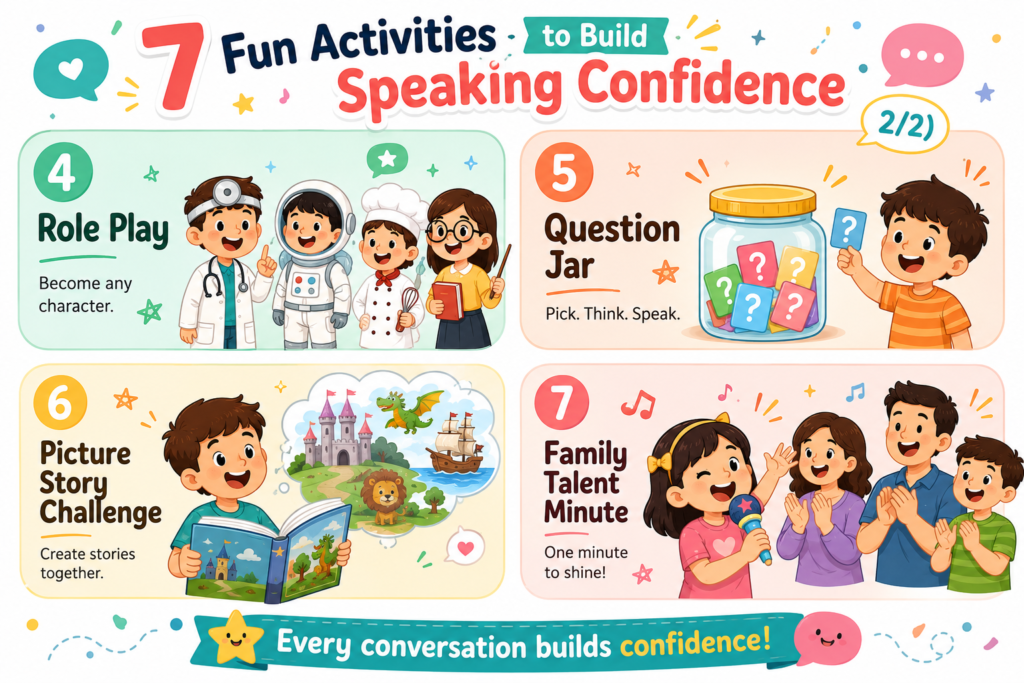
4. Puppet Shows and Role-Play
Puppets or stuffed toys make excellent “co-speakers.” Shy children often open up more freely when a character does the talking for them.
5. The Two-Minute Topic Game
Pick a random word (like “rainbows” or “robots”) and ask your child to speak on it for two minutes. This sharpens quick thinking and spontaneous expression.
6. Family Debate Nights
Pick light, fun topics like “Cats vs Dogs” or “Summer vs Winter” and let family members take sides. Debating builds structured thinking and persuasive speaking.
7. Show-and-Tell at Home
Before school presentations, have your child present their project to the family first. This builds a comfortable rehearsal loop before the real audience.
Quick Reference: Activity vs Skill Built
| Activity | Core Skill Developed |
|---|---|
| Dinner Table Storytelling | Spontaneous speaking |
| Mirror Talk | Body language awareness |
| Record and Replay | Self-correction, clarity |
| Puppet Shows | Overcoming shyness |
| Two-Minute Topic Game | Quick thinking |
| Family Debate Nights | Persuasive speaking |
| Show-and-Tell at Home | Presentation rehearsal |
Tips for Parents While Practicing
- Praise effort, not just performance.
- Avoid correcting every mistake mid-speech; save feedback for after.
- Keep sessions short (5–10 minutes) so it stays fun, not forced.
- Let your child choose topics they’re passionate about.
- Celebrate small wins, like finishing a sentence without hesitation.
- Rotate activities weekly so practice never feels repetitive or boring.
Building Confidence Beyond Home

While home practice lays the groundwork, structured environments matter too. Schools that encourage inquiry-based learning and regular presentations, like circle time discussions, project showcases, and classroom debates, help children transfer home confidence into real classroom settings naturally.
The two work best together: home builds comfort, school builds application.
FAQs
1. At what age should kids start practicing public speaking?
Children as young as 4–5 can begin with simple storytelling and show-and-tell activities at home.
2. How often should we practice at home?
Short, 5–10 minute sessions, 2–3 times a week, work better than long, infrequent practice.
3. My child gets nervous even at home. What should I do?
Start with low-pressure activities like puppet shows or mirror talk before moving to family audiences.
4. Does reading aloud help with public speaking?
Yes, reading aloud daily improves fluency, pronunciation, and confidence with using their voice.
5. How can schools support what we do at home?
Look for schools that offer regular presentation opportunities, classroom discussions, and project-based learning to reinforce home practice.
Want to see how these skills come alive in the classroom? Explore Vega Schools’ approach to communication and confidence-building.
Infrastructure, facilities, and experienced teachers are a big asset to the learning & development of students, be it for Nursery, Primary or Senior children making Vega Schools the best schools in Gurgaon. For information about admission, please visit the Vega Schools campuses in Sector 48 and Sector 76 Gurugram. Get the best education for you child in New Gurgaon and be part of the top school infrastructure for sector 78, Sector 83, Sector 85, Sector 90, Sector 102, Sector 106 in Gurgaon, near Dwarka Expressway.