
- The night before a new school year, many children can’t sleep.
- They ask “what if” questions that seem endless.
- First-day anxiety is real, remarkably common, and with the right support — entirely manageable.
- As a parent, your instinct is to reassure.
- But how you respond in the days leading up to that first bell matters just as much as what you say on the morning itself.
The night before a new school year, many children can’t sleep. Their stomach hurts. They ask “what if” questions that seem endless. First-day anxiety is real, remarkably common, and with the right support — entirely manageable.
As a parent, your instinct is to reassure. But how you respond in the days leading up to that first bell matters just as much as what you say on the morning itself.
Is It Normal? Absolutely.
Anxiety about a new grade affects children across all ages — from Class 1 to Class 9. A new teacher, unfamiliar classmates, higher academic expectations, or simply the unknown can all trigger genuine worry in otherwise confident children.
The key distinction to watch for is between healthy anticipatory nerves — which typically resolve within the first week — and persistent anxiety that continues well beyond the initial adjustment period.
What Children Are Really Worried About
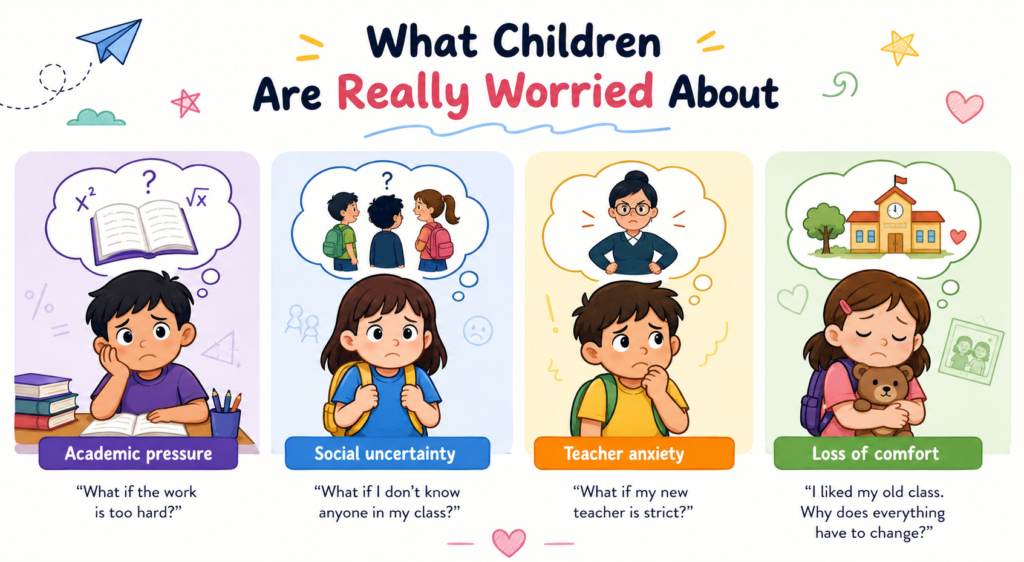
Before offering solutions, listen first. Most first-day fears fall into a few common categories:
- Academic pressure: “What if the work is too hard?”
- Social uncertainty: “What if I don’t know anyone in my class?”
- Teacher anxiety: “What if my new teacher is strict?”
- Loss of comfort: “I liked my old class. Why does everything have to change?”
Naming the specific fear out loud often reduces its power considerably.
How to Support Your Child: Before, During, and After
Before the First Day
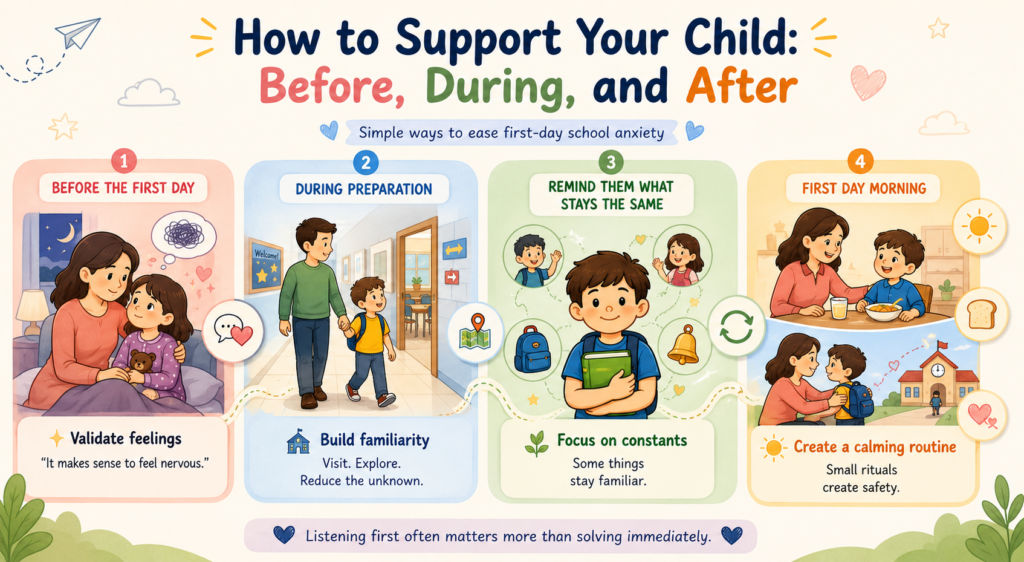
Validate, don’t dismiss. Saying “You’ll be fine” shuts down the conversation. Instead, try “It makes sense that you’re nervous — starting something new can feel that way.” Acknowledgement alone is calming.
Familiarise where possible. If your school allows it, visit the classroom or building beforehand. Familiarity with the physical space reduces one layer of the unknown significantly.
Talk about what stays the same. Amid all the change, remind your child of constants — friends returning, favourite subjects continuing, familiar school routines picking back up.
Create a morning ritual. A consistent, calm morning routine on Day 1 — a favourite breakfast, a short walk, an encouraging word — signals safety and predictability to an anxious child.
On the First Day
- Arrive a little early so your child isn’t rushed or overwhelmed by crowds
- Keep goodbyes warm but brief — prolonged farewells often increase separation anxiety
- Give them something small to look forward to after school: a favourite snack, a chat, a treat
In the First Week
| Day | What to Focus On |
|---|---|
| Day 1–2 | Listen more than you advise — ask open questions |
| Day 3–4 | Celebrate small wins: a new name learned, a question asked in class |
| Day 5 | Check in on how feelings have shifted since Day 1 |
Most children settle naturally within the first week once routine kicks in.
When to Be More Attentive
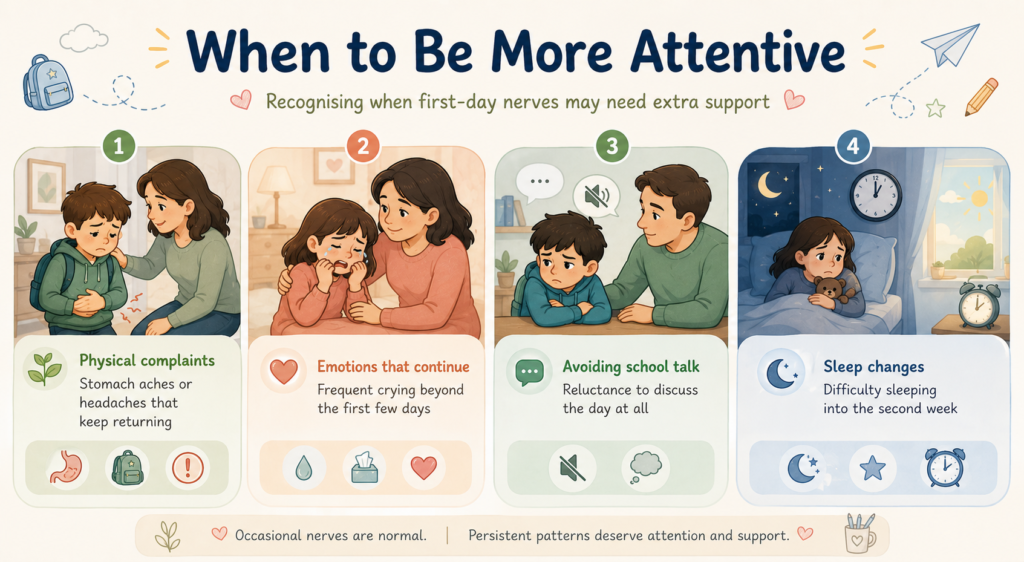
Occasional nerves are healthy. However, watch for signs that anxiety may need additional support:
- Persistent stomach aches or headaches on school mornings
- Frequent crying or emotional outbursts beyond the first few days
- Reluctance to discuss school at all
- Sleep disruption continuing into the second week
In these cases, a conversation with the class teacher or school counsellor is a constructive next step — not an overreaction.
A Word for Parents Who Feel It Too
First-day anxiety isn’t always just the child’s. Parents feel it too — and children pick up on parental worry quickly. Projecting calm, even when you don’t fully feel it, genuinely helps regulate your child’s emotional state. Your steadiness is their anchor.
FAQs
Q: How long does first-day school anxiety typically last? For most children, nerves settle within 3–5 school days once routine and familiarity set in.
Q: Should I keep my child home if they’re very anxious? Generally, no. Avoidance tends to increase anxiety over time. Gentle, consistent attendance with emotional support works better.
Q: What if my child cries at drop-off? Stay calm, keep the goodbye brief and loving, and trust the teacher. Most children settle quickly once the school day begins.
Q: How do I talk to my child about their anxiety without making it worse? Use open, curious questions rather than leading ones. “How are you feeling about tomorrow?” works better than “Are you nervous about tomorrow?”
Q: At what point should I involve a professional? If anxiety is significantly disrupting sleep, appetite, or daily functioning beyond two weeks, consider consulting a child psychologist or counsellor.
Infrastructure, facilities, and experienced teachers are a big asset to the learning & development of students, be it for Nursery, Primary or Senior children making Vega Schools the best schools in Gurgaon. For information about admission, please visit the Vega Schools campuses in Sector 48 and Sector 76 Gurugram. Get the best education for you child in New Gurgaon and be part of the top school infrastructure for sector 78, Sector 83, Sector 85, Sector 90, Sector 102, Sector 106 in Gurgaon, near Dwarka Expressway.