
- Summer has a way of quietly dismantling every sleep habit your child worked hard to build.
- Late-night screen time, flexible wake-ups, and endless “just five more minutes” have a cumulative effect — and by July, most kids are sleeping two to three hours later than they should be for school.
- You don’t need to jolt them back overnight.
- A gradual, well-planned approach makes the transition smoother for everyone.
- Why Summer Sleep Shifts Are a Real Problem During vacation, the body’s internal clock — the circadian rhythm — naturally drifts later.
Summer has a way of quietly dismantling every sleep habit your child worked hard to build. Late-night screen time, flexible wake-ups, and endless “just five more minutes” have a cumulative effect — and by July, most kids are sleeping two to three hours later than they should be for school.
The good news? You don’t need to jolt them back overnight. A gradual, well-planned approach makes the transition smoother for everyone.
Why Summer Sleep Shifts Are a Real Problem
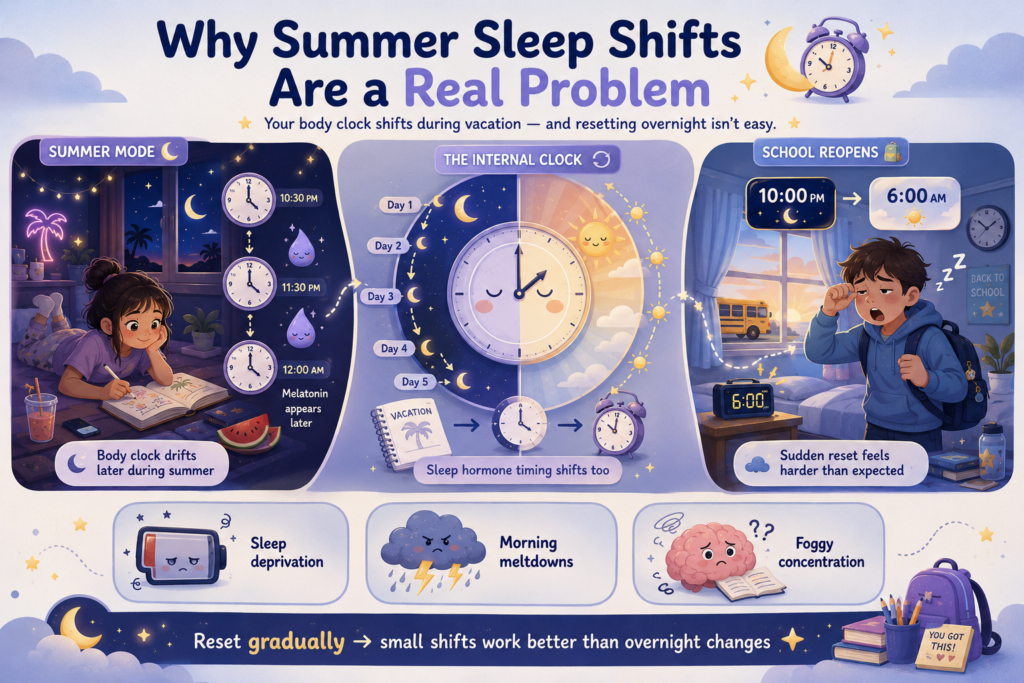
During vacation, the body’s internal clock — the circadian rhythm — naturally drifts later. Children start producing melatonin (the sleep hormone) later in the evening, making early bedtimes feel impossible rather than just inconvenient.
Forcing an abrupt 10 PM → 6 AM shift the night before school reopens leads to sleep deprivation, morning meltdowns, and foggy concentration in class — exactly the opposite of a great first day back.
The 2-Week Taper Plan
Start at least 14 days before school reopens. Move bedtime and wake-up time 15–20 minutes earlier every 2–3 daysinstead of overnight.
| Days Before School | Target Bedtime | Target Wake-Up |
|---|---|---|
| 14–12 days | 10:30 PM | 7:30 AM |
| 11–9 days | 10:00 PM | 7:00 AM |
| 8–6 days | 9:30 PM | 6:30 AM |
| 5–3 days | 9:00 PM | 6:15 AM |
| 2–1 days | 8:30–9:00 PM | 6:00–6:15 AM |
Adjust starting times based on where your child currently is. The goal is a gentle slope, not a cliff.
Small Habits That Accelerate the Reset
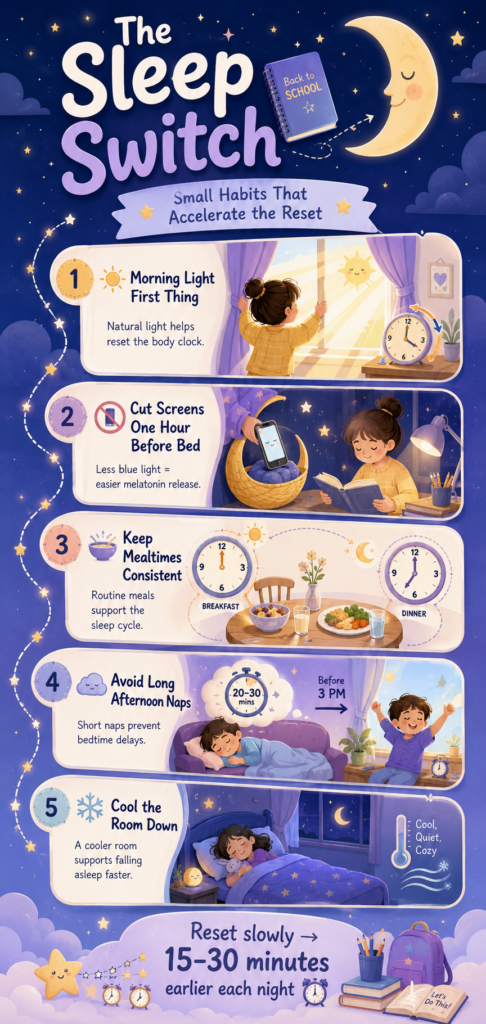
You don’t need a complex system. These practical shifts work with the body, not against it:
- Morning light first thing — Open curtains immediately after waking. Natural light suppresses melatonin and signals the brain to shift its clock forward.
- Cut screens an hour before bed — Blue light delays melatonin production. Swap devices for a book, drawing, or calm conversation.
- Keep mealtimes consistent — Breakfast and dinner at the same time each day help anchor the circadian rhythm beyond just sleep.
- Avoid long afternoon naps — If your child naps, cap it at 20–30 minutes and keep it before 3 PM.
- Cool the room down — Body temperature drops naturally before sleep. A slightly cooler bedroom environment supports faster sleep onset.
A Note for Parents of Younger Children (Ages 5–10)
Younger kids often need 10–11 hours of sleep. If your child currently sleeps at midnight and wakes at 10 AM, start the taper three weeks out instead of two. Be consistent with the routine — bath, story, lights out — even before the new bedtime feels natural. The ritual itself becomes a sleep cue over time.
When Your Child Resists
Resistance is normal. The body genuinely doesn’t feel sleepy at the earlier time — it’s not stubbornness. Acknowledge that, and avoid turning bedtime into a battle.
Instead, frame it as preparation: “School is starting soon and we want you to feel your best on Day 1.” Children respond better when they understand the why rather than being handed a rule.
FAQs
Q1. How many days before school should I start adjusting bedtime? Ideally 14 days, but even 7–10 days of gradual shifting makes a noticeable difference compared to an overnight change.
Q2. What if my child simply can’t fall asleep earlier? Don’t force it. Focus on the wake-up time first — earlier mornings will naturally create earlier tiredness by evening within a few days.
Q3. Do teenagers need a different approach? Yes. Teens have a biologically later sleep clock. Aim to shift their bedtime by 30 minutes every 3 days rather than every 2.
Q4. Is one late night okay during the transition? One late night can set the reset back by 1–2 days. Try to stay consistent, especially on weekends.
Q5. How much sleep does a school-going child need? Children aged 6–12 need 9–11 hours. Teens need 8–10 hours. Prioritising this directly impacts mood, memory, and learning.
Infrastructure, facilities, and experienced teachers are a big asset to the learning & development of students, be it for Nursery, Primary or Senior children making Vega Schools the best schools in Gurgaon. For information about admission, please visit the Vega Schools campuses in Sector 48 and Sector 76 Gurugram. Get the best education for you child in New Gurgaon and be part of the top school infrastructure for sector 78, Sector 83, Sector 85, Sector 90, Sector 102, Sector 106 in Gurgaon, near Dwarka Expressway.