
- It’s April, you’re mid-lesson, and you look out at a classroom that has clearly — mentally — already left for summer.
- One student staring at the ceiling like it personally offends them.
- Why April Is the Hardest Month to Teach (And What Actually Helps) April is a strange in-between — especially in fast-paced academic environments like Gurgaon, where exam pressure builds early and student burnout is real.
- And before you roll your eyes at the buzzword — this isn’t about letting kids play Minecraft instead of doing maths.
- It’s about taking the mechanics that make games compelling — progress, challenge, reward, teamwork — and wrapping your actual curriculum inside them.
Every teacher knows the feeling. It’s April, you’re mid-lesson, and you look out at a classroom that has clearly — mentally — already left for summer. Eyes glazing over. Pencils tapping. One student staring at the ceiling like it personally offends them.
You haven’t lost them. You just need to change the game. Literally.
Why April Is the Hardest Month to Teach (And What Actually Helps)
April is a strange in-between — especially in fast-paced academic environments like Gurgaon, where exam pressure builds early and student burnout is real.
Gamification bridges that gap. And before you roll your eyes at the buzzword — this isn’t about letting kids play Minecraft instead of doing maths. It’s about taking the mechanics that make games compelling — progress, challenge, reward, teamwork — and wrapping your actual curriculum inside them.
The content stays. The boredom doesn’t.
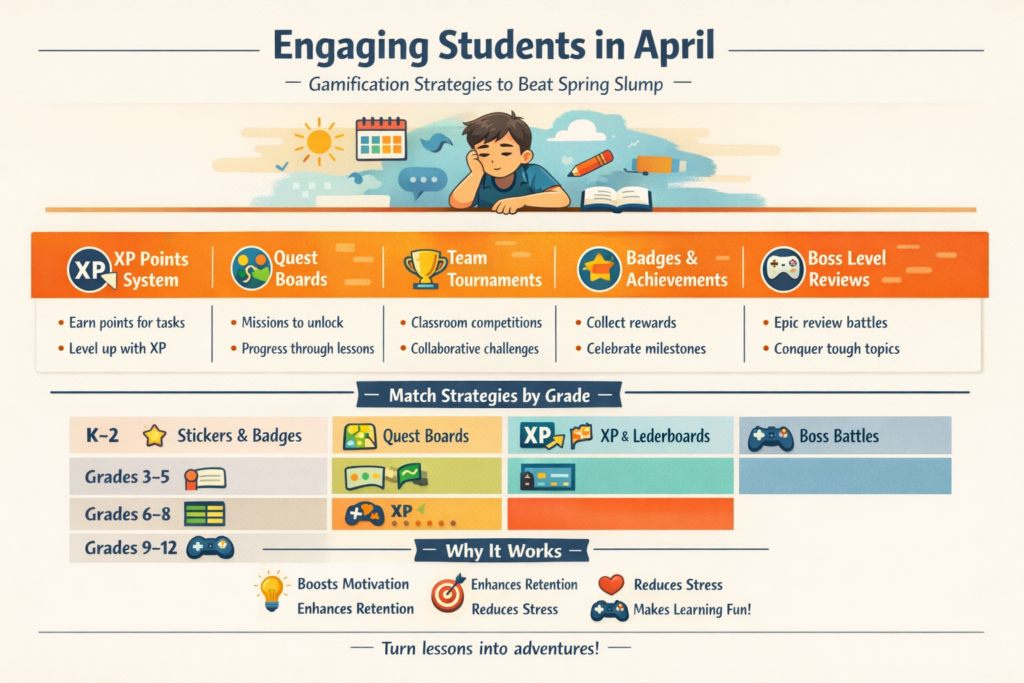
5 Strategies Worth Trying This April
1. The XP Points System Swap traditional marks temporarily for Experience Points. Students earn XP for participation, homework, quiz scores, even helping a classmate. Watching a number climb does something a letter grade simply doesn’t — even your most disengaged learners start paying attention.
2. Quest Boards Turn your weekly curriculum into a mission map. Complete one lesson, unlock the next. Suddenly revision feels like progress. Works brilliantly for science units, history timelines, and reading challenges.
3. Team Tournaments Weekly mini-competitions tied to lesson content — vocabulary battles, maths relays, grammar showdowns. The competitive element makes students want to know the answer. No worksheet has ever reliably done that.
4. Badges and Achievements “First to finish.” “Helped three classmates.” “Mastered fractions.” Create badges for real milestones. Younger students respond with an enthusiasm that will genuinely surprise you.
5. Boss Level Reviews Reframe test prep as a Boss Battle — the class works together to defeat a hard concept or problem set. Collaborative, low-pressure, and far more effective than re-reading notes for the fourth time.

Matching Strategy to Grade Level
| Grade | What Works Best | Tools to Try |
| K–2 | Badges + sticker rewards | ClassDojo |
| 3–5 | Quest boards + team points | Kahoot!, Seesaw |
| 6–8 | XP system + leaderboard | Classcraft, Gimkit |
| 9–12 | Boss battles + scenario missions | Blooket, Quizizz |
How Schools Like Vega Schools Gurgaon Are Leading the Way
Progressive schools in Gurgaon are already moving beyond traditional instruction — and gamification is part of that shift. At institutions like Vega Schools, Gurgaon, experiential and engagement-first learning is embedded into how teachers approach the classroom.
The results speak for themselves: when students feel invested in the process, not just the outcome, retention improves, anxiety reduces, and the classroom energy transforms entirely.
For Gurgaon parents evaluating schools, asking about gamified and activity-based learning approaches is worth adding to your list.
Does It Actually Teach Anything?
Yes — if you do it right. The game mechanics are the wrapper, not the lesson. Every point, quest, and badge should connect to a real learning objective. Reward effort and growth, not just correct answers. And rotate strategies — novelty fades fast.
FAQs
1. Does gamification work across all subjects?
Yes — maths, science, English, history. If content can become questions or missions, it can be gamified.
2. How much class time does it take?
Most activities run 10–20 minutes — replacing drills, not adding to them.
3. Do older students find it childish?
Rarely. Teens respond well to XP systems and leaderboards when the stakes feel genuine.
4. What about students who dislike competition?
Quest boards and badge systems work without any competitive element — purely personal progress tools.
5. Are these tools free?
Kahoot!, Blooket, and Quizizz all offer solid free tiers — no paywall for the basics.
infrastructure, facilities, and experienced teachers are a big asset to the learning & development of students, be it for Nursery, Primary or Senior children making Vega Schools the best schools in Gurgaon. For information about admission, please visit the Vega Schools campuses in Sector 48 and Sector 76 Gurugram. Get the best education for you child in New Gurgaon and be part of the top school infrastructure for sector 78, Sector 83, Sector 85, Sector 90, Sector 102, Sector 106 in Gurgaon, near Dwarka Expressway.