
One of the most significant decisions parents make is which school is best for their child. Many families now find themselves comparing traditional and progressive schools because there are so many options for education. Although both systems seek to foster students’ development, there are notable differences between them in terms of curricular approach, teaching style, and general learning environment. Parents can make an informed decision that meets their child’s requirements by being aware of these variances.
Traditional Schools: What Are They?
The educational model used in traditional schools is regimented and standardised. Usually, they emphasise teacher-led instruction, set curricula, and academic achievement. Under this arrangement, pupils are supposed to learn through listening, memory, and frequent assessments, with the teacher serving as the main source of information.
Conventional education frequently highlights:
- Learning with textbooks
- Frequent assessments and evaluations
- Regularity and discipline
- Classrooms focused on the teacher
Students who do well in a disciplined setting and who like precise rules and expectations would benefit greatly from this program.
Progressive Schools: What Are They?
Student-centred learning and comprehensive development are the main focuses of progressive schools. These educational institutions promote creativity, critical thinking, and practical experiences over mindless memorisation. Learning is frequently participatory, project-based, and related to real-world circumstances.
Typical components of progressive education include:
- Learning via inquiry
- cooperative group exercises
- Adaptable teaching strategies
- Emphasise social and emotional growth
Independent learners who can look beyond textbooks and adjust to contemporary difficulties are the goal of progressive schools.
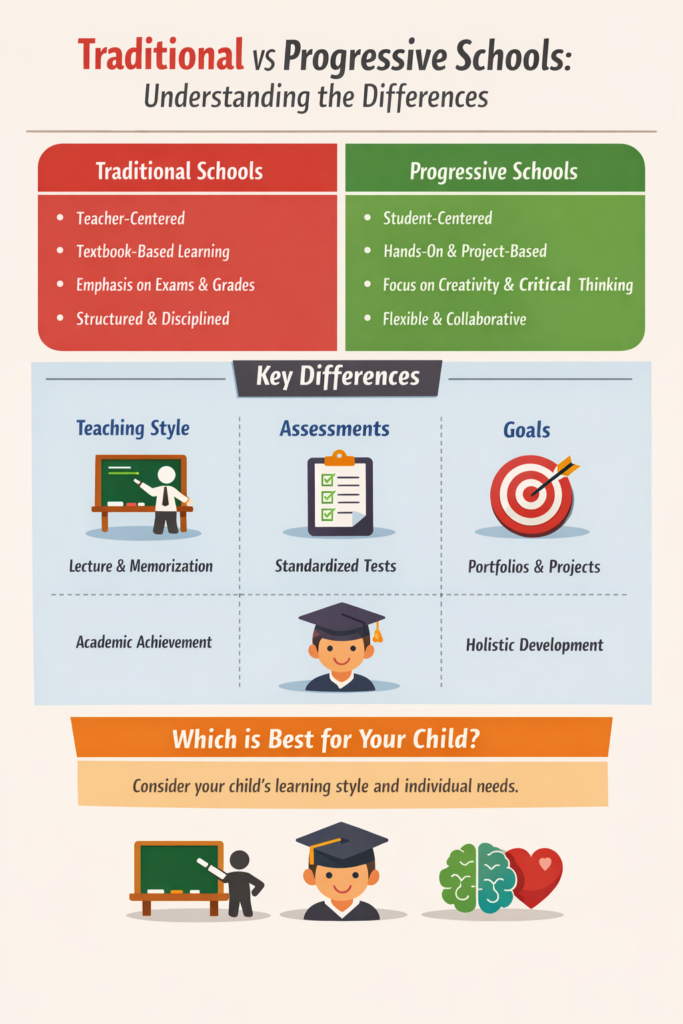
Important Distinctions Between Progressive and Conventional Education
The method of instruction is one significant distinction. Progressive schools promote inquiry and dialogue, whereas traditional schools place more emphasis on direct instruction.
The assessment system is another distinction.
While progressive schools may use portfolios, presentations, and ongoing evaluation, traditional schools still rely on tests and grades.
While progressive education places equal emphasis on life skills, creativity, and personal development, traditional education frequently views academic success as the primary objective.
What’s the Best School for Your Child?
There isn’t a single, universal solution. Parents ought to take into account their child’s personality, learning preferences, and long-term objectives. While some kids do best in regimented situations, others do best in adaptable, engaging spaces.
It’s beneficial to search for educational institutions that give the best of both worlds by striking a balance between academics and general growth.
In conclusion
Making the best educational decision requires an understanding of the distinctions between progressive and traditional schools. Progressive schools encourage creativity, critical thinking, and holistic learning, whereas traditional schools provide academic structure and discipline. The ideal school fosters your child’s individual potential and equips them to meet problems in the real world as well as succeed academically.
FAQs
1. What distinguishes progressive education from traditional education?
Progressive schools promote experiential learning and are student-centred, whereas traditional schools are teacher-centred and exam-focused.
2. Are progressive educational institutions superior to conventional ones?
Not always. The child’s educational needs and preferred learning method will determine the optimal option.
3. Do progressive schools use the ICSE or CBSE curriculum?
Many forward-thinking schools adopt contemporary teaching techniques within the CBSE or ICSE framework.
4. What kind of educational institution fosters the development of the whole person?
In addition to academics, progressive schools frequently place a greater emphasis on emotional and overall development.
5. Is it possible for a school to be both innovative and traditional?
Indeed, a lot of contemporary schools combine progressive teaching methods with regimented academics.
Vega Schools offers holistic education to children in Delhi NCR and is rated among the top Schools in Gurgaon. Its modern infrastructure, facilities, and experienced teachers are a big asset to the learning & development of students, be it for Nursery, Primary or Senior children making Vega Schools the best schools in Gurgaon. For information about admission, please visit the Vega Schools campuses in Sector 48 and Sector 76 Gurugram. Get the best education for you child in New Gurgaon and be part of the top school infrastructure for sector 78, Sector 83, Sector 85, Sector 90, Sector 102, Sector 106 in Gurgaon, near Dwarka Expressway.