
- Many parents view test results and report cards as primary indicators of success in today’s competitive academic environment.
- Although grades can offer valuable information, they don’t always accurately reflect a child’s skills, development, or potential.
- Each child has strengths that go beyond standardised tests, learns differently, and grows at a different rate.
- Parents are better equipped to assist their child’s entire development when they are aware of their learning progress without comparing grades.
- Parents may foster resilience, confidence, and a lifetime love of learning by reorienting the focus from numbers to abilities, effort, and personal development.
Many parents view test results and report cards as primary indicators of success in today’s competitive academic environment. Although grades can offer valuable information, they don’t always accurately reflect a child’s skills, development, or potential. Each child has strengths that go beyond standardised tests, learns differently, and grows at a different rate.
Parents are better equipped to assist their child’s entire development when they are aware of their learning progress without comparing grades. Parents may foster resilience, confidence, and a lifetime love of learning by reorienting the focus from numbers to abilities, effort, and personal development.
1. Emphasise developing skills
Try asking, “What did you learn?” rather than, “What marks did you get?” This small change enables kids to focus on learning new skills and information rather than ranking their performance. See gains in writing clarity, inventiveness, problem-solving skills, or reading fluency. Compared to a numerical score, these indicators frequently provide greater insight into actual learning development.
2. Monitor Individual Development Over Time
Every youngster starts somewhere. Instead of comparing your child’s current performance to that of their peers, compare it to their prior accomplishments. For instance, it is significant if your child used to have trouble with multiplication but is now able to answer problems on their own. Monitoring one’s own progress increases motivation and relieves needless stress.
3. Use Conversations to Evaluate Understanding
Talk to your youngster about the subjects they are learning. Request that they use their own words to describe an idea or relate it to actual circumstances. A youngster exhibits profound comprehension when they are able to impart what they have learnt. Without depending on grades, meaningful interactions are an effective way to interpret learning progress.
4. Examine Attitude and Effort
Resilience, curiosity, effort, and consistency are all powerful markers of academic progress. Take note of whether your child completes homework on their own, asks for assistance when necessary, or demonstrates excitement for new subjects. Long-term success is frequently predicted by a good attitude toward learning more precisely than by test results.
5. Interact with Instructors
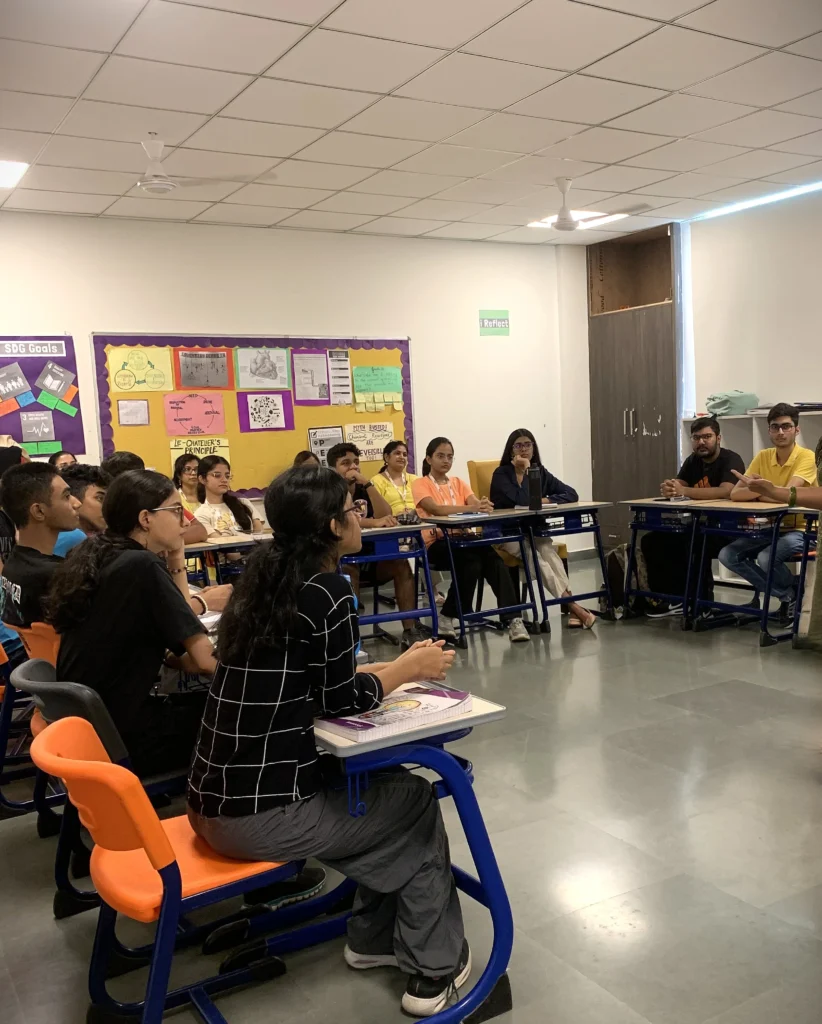
In addition to tests, teachers evaluate students’ conduct, projects, presentations, and participation in class. Maintaining regular contact with educators gives you a more comprehensive understanding of your child’s areas of strength and growth. Discussions between parents and teachers aid in the comprehensive interpretation of learning development.
6. Promote the Establishment of Goals
Encourage your kid to create attainable, skill-based objectives, like learning a difficult subject, reading an additional book each month, or becoming better at handwriting. Instead of encouraging rivalry, children’s accomplishment of their own goals fosters intrinsic drive.
7. Appreciate Your Non-Academic Skills
Critical thinking, creativity, collaboration, and emotional intelligence are all components of learning growth. Essential life skills are developed via athletics, art, and problem-solving activities. A balanced perspective of your child’s growth is ensured by acknowledging their strengths.
In conclusion
Parents may raise self-assured, competent students by comprehending learning progress without comparing grades. A child’s academic path is made up of much more than just their grades. Parents may foster a nurturing environment that prioritises learning over competitiveness by emphasising skill development, personal growth, effort, and open communication. Children become resilient, curious, and have a lifetime love of learning when they feel valued for their accomplishments rather than evaluated only on their numerical scores.
FAQ
- Why shouldn’t parents compare grades?
Stress, low self-esteem, and excessive competition can result from comparing grades. It diverts attention from real education and individual development.
2. Without grades, how can I assess my child’s intellectual progress?
Over time, you can see gains in abilities, comprehension, effort, involvement in class, and goal attainment.
3. What inquiries ought to be substituted for “What did you score?”
Pose queries such as “What was difficult and how did you overcome it?” or “What new thing did you learn today?”
4. Can academic performance be impacted by concentrating less on grades?
No. In fact, since children learn more confidently and with less worry when comprehension and skills are prioritised, performance frequently increases.
5. How do educators evaluate students’ learning progress?
In addition to test results, teachers give thorough comments on conduct, participation, understanding, and project work.
Vega Schools offers holistic education to children in Delhi NCR and is rated among the top Schools in Gurgaon. Its modern infrastructure, facilities, and experienced teachers are a big asset to the learning & development of students, be it for Nursery, Primary or Senior children making Vega Schools the best schools in Gurgaon. For information about admission, please visit the Vega Schools campuses in Sector 48 and Sector 76 Gurugram. Get the best education for you child in New Gurgaon and be part of the top school infrastructure for sector 78, Sector 83, Sector 85, Sector 90, Sector 102, Sector 106 in Gurgaon, near Dwarka Expressway.